

GBR Friday | The quiet migration in the range business: from measuring golfers to serving the whole room
Why venues are replacing established range technology, Italy's potential as a major golf market, and a new $120 retail proposition.


HOUSEKEEPING BEFORE WE START: Golf Business Review is made possible by the support of its readers and by carefully selected partnerships that sustain our independent editorial work. If you would like to support independent, long-term coverage of the global golf industry — and access the full GBR archive — subscribe here.
HOW TO PARTNER WITH US: If you are interested in contributing to and strengthening our content offering as a partner, company, or institution, we would be pleased to hear from you at newsroom@golfbusinessreview.com.
Hello GBR community,
We open today with a pattern we’ve been watching build for months: venues that spent real money on established range technology are pulling it out and starting again. The lead story traces what’s behind the switch, and why nearly every move points in the same direction.
Also in today’s edition, a $19.99 card game built for the table is making its bid for the pro-shop counter — with register math that doubles the shop’s money and a founder exhibiting at the PGA Buying Summit in Frisco this weekend.
Enjoy today’s edition of GBR and have a good weekend.
NOT ALL RANGE TECH IS EQUAL: THE QUIET MIGRATION IN THE RANGE BUSINESS
Something has nagged at us for the better part of a year, and it shows up first in the installations. Venues that spent real money on established ball-tracking have been pulling it out and starting again. Not upgrading around it. Replacing what they already owned. Once is a one-off. Past a dozen, it’s a pattern worth understanding.
The venues themselves are the first clue. This isn’t one corner of the market: Chelsea Piers has made the move; so has Bethpage. When a high-volume commercial site and one of the most credibility-conscious practice destinations in American golf land on the same decision, coincidence stops being a satisfying answer.

The second clue is where they’re going. In nearly every case, the replacement has been the same: Inrange. And nearly every venue that made the switch has grown revenue since — a hit rate rare enough in any business to make you ask what these operators know that the rest of the market doesn’t.
None of it comes cheap. Ripping out working kit costs real money and real disruption, and the incumbents it replaces built the measurement standard this industry trusts. That is exactly what makes the volume of moves worth explaining.
The short version: it has almost nothing to do with how well any of these systems tracks a golf ball. The operators switching haven’t bought a better tracker. They’ve changed categories — from software built to measure a golfer to software built to earn from every kind of customer who walks in.
We’ve laid it all out in today’s piece: the economics of the ceiling most ranges never notice, the honest case for staying put, and the full list of venues now running the new model at both ends of the market. The list doesn’t look finished, either. The talk in operator circles is that more marquee venues are weighing the same move.
Read the full story: Not All Range Tech Is Equal: Why Operators Are Switching Their Tech to Maximise Revenue.
THE $120 DECISION: A CARD GAME BIDS FOR THE PRO-SHOP COUNTER
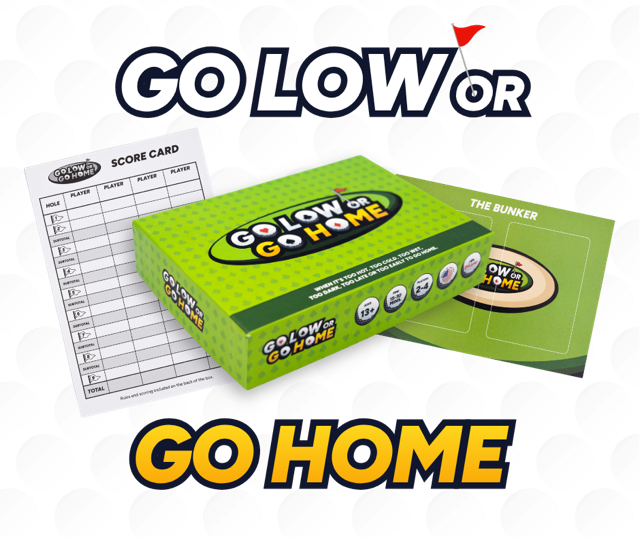
Play Nine proved a golf-themed card game earns a place at the register, moving units in the hundreds of thousands across retail and online channels, by the company’s own account. It did it as a casual, family-friendly product. Go Low or Go Home is built for the table Play Nine leaves untouched: a patented five-card game with three known cards in hand and two unknown cards in the bunker. Its formats are lifted from how tournament golf is actually played, closer in feel to Texas Hold’em with golf cleats swapped in for cowboy boots.
The mechanics run like a hole of golf, where shot selection is a matter of tradeoffs. A dealer hands each player two face-down bunker cards and three cards in hand, and every turn is a shot with its own risk and reward:
Draw from the discard pile and play it as your shot.
Draw from the deck and either play it or discard.
Lay down a card from your hand.
Gamble on one of your hidden bunker cards.
The only way out of the bunker is to discard that card on a turn or play it face-up as a shot. The lowest hand wins the hole.
The two products share the same $19.99 MSRP. Wholesale is $10, and the standard opening order is twelve units, $120 in total. Each sale leaves $9.99 in the shop, a 100% margin that doubles the counter’s money, and six units sold cover the whole order. It isn’t a pitch to replace Play Nine. It’s a pitch for a second SKU in a category the shelf already knows how to sell.
The founder is John Beran, a former CPA and MBA who filed the patent and holds the trademark himself, after an idea born mid-cruise and a Wisconsin childhood where winter took the golf season away. Where Play Nine is an at-home parlor game, Go Low gives the foursome a reason to stay at the table and compete.
The early proof is blunt. At its inaugural tournament at Midland Trail Golf Course in Louisville, fourteen of sixteen players bought the game on the spot. A women’s event follows in August, and the company is building the dealer and rep network to run more. That is also its broader pitch: revenue for the hours a course can’t currently sell, from rainouts to the simulator bay to the 19th hole. A future Golf Genius integration would put that competition on tournament software courses already run, something Play Nine’s family-friendly format was never built for.
The buyers are worth the shelf. The National Golf Foundation puts the average core golfer’s holiday gift spending near $934, roughly 50 percent above the typical shopper, and 13 million core golfers drive more than 90 percent of golf purchases. A $19.99 box is easy math against a number like that. Beran exhibits at the PGA Buying Summit in Frisco this Sunday through Wednesday and opens holiday pre-orders in the coming weeks.
CANADA TARIFFS COULD RAISE COSTS FOR U.S. GOLFERS
U.S. golfers could face higher prices on Canadian-made golf equipment from August 19.
EssentiallySports reported that President Donald Trump’s additional 50% tariffs on certain Canadian imports could affect golf brands including Haywood Golf, Blacksmith Putters, SGC Putters, Levelwear, Sunice, Dormie Workshop and Pioneer Golf Co., with the White House saying the measures were imposed under Section 338 of the Tariff Act of 1930 to address what it called Canada’s “discriminatory treatment” of U.S. commerce. The White House said the tariffs, signed on July 20, are intended to offset disadvantages facing American exports including cars, alcohol and dairy, and will take effect 30 days after signing. Canadian Prime Minister Mark Carney said the move was “the latest in a series of unilateral U.S. trade actions” and argued it violated CUSMA, while Canadian Manufacturers and Exporters chief executive Dennis Darby called the tariffs “an alarming escalation” that could damage businesses and consumers in both countries.
NORTH AMERICAN GOLFERS LOOK BEYOND SCOTLAND AND IRELAND
North American golfers are showing greater interest in mainland European golf destinations. European Tour Destinations said tour operators at the 2026 IAGTO North America Convention reported rising demand for Spain, Portugal, France and Greece, while representatives from Costa Navarino, La Hacienda Links, Camiral, Palmares Ocean Living & Golf and Quinta do Lago used the Riviera Maya event to build relationships with buyers and travel specialists.
Ian Knox, Head of European Tour Destinations, said Scotland and Ireland remain the leading international destinations for U.S. and Canadian golfers, but mainland Europe is gaining from “expanding direct air routes, favorable exchange rates and the appeal of year-round golf.” Operators also reported stronger demand for experience-led travel built around culture, gastronomy and wellness, with Knox adding that “the destination itself matters as much as the course” and that inflation has not been a major barrier because many North American outbound golf travelers are high-net-worth individuals.
TOPGOLF RENEWS FIRST TEE PARTNERSHIP TO SUPPORT YOUTH GOLF
Topgolf has renewed its long-running partnership with First Tee. The youth development organization, which uses golf to build character, confidence and resilience, reaches more than 3.1 million children and teenagers each year through 150 U.S. chapters, 2,000 program locations and 12,000 schools and youth centers.
Topgolf, a trustee and strategic partner, has supported First Tee through chapter programming at more than 25 venues, alumni engagement, venue activations and promotion across more than 28,000 digital screens through Topgolf Media Networks. First Tee participants and alumni will receive $20 off gameplay at participating Topgolf venues through December 30, with the renewal following First Tee’s Game Changers Academy in Minneapolis and coming as youth participation in golf has risen 40% over five years. Topgolf CEO David McKillips said the partnership reflects a shared commitment to “expanding access to the game and the life skills that come with it,” while First Tee CEO Greg McLaughlin said Topgolf provides young people with “an engaging introduction to the game of golf.”
AVA GOLF LAUNCHES DATA-LED IMPROVEMENT PLATFORM
AVA Golf has officially launched its new website. The ParOne-owned platform is designed to turn golf performance data into personalized improvement plans, with eligible Arccos and Garmin users now being onboarded from its waitlist.
AVA connects with technology golfers already use, analyses data from rounds and practice sessions, identifies the trends most affecting scores, and delivers tailored instructional video playlists that evolve with each player’s game. The launch comes as National Golf Foundation data cited by AVA shows around 40% of regular golfers now use a golf app, with founder and CEO JR Charles saying the platform “bridges the gap between data and improvement”, while engineering director Aron Schüler said it helps golfers understand “what’s truly costing them strokes”. The instructional library includes Golf Digest 50 Best Teacher Cheryl Anderson, GOLF Magazine Top 100 Teacher Mike Malizia, Jason Birnbaum, PGA TOUR Golf Academy coaches and other recognized teaching professionals, with further technology integrations planned.
MYTIME ACTIVE REPORTS RECORD GOLF PARTICIPATION
Mytime Active has reported record golf participation across its venues. The charity, which manages 10 UK golf courses including six in the Midlands region, recorded almost 700,000 rounds between March 2025 and March 2026, equivalent to around 50 million balls struck on-course, a further 500,000 range balls and an estimated three million kilometers walked by golfers. Nearly 3,500 new customers booked to play for the first time, with facilities including nine and 18-hole courses, a 24-bay driving range with 12 heated bays and Toptracer, practice putting and chipping greens, and PGA-led adult and junior lessons. Mytime Active said the average player age is 57, with 40% of members under 25, 8% under 16, and men making up 82% of players, while chief executive Steve May said the aim is to provide “affordable, accessible, competitive golf in welcoming and sociable surroundings.”
FORMER 3M CHAIRMAN MICHAEL ROMAN JOINS PGA TOUR POLICY BOARD
Michael F. Roman has joined the PGA TOUR Policy Board as an Independent Director.
The former 3M chairman and chief executive was elected at the Tour’s June 22 board meeting in Hartford, Connecticut, and fills an open Independent Director seat, with the appointment effective immediately. Roman spent more than 35 years at 3M, holding leadership roles in the United States, Europe and Asia before becoming CEO in 2018, chairman in 2019 and later executive chairman; he now serves on the board of Abbott Laboratories and brings experience in corporate governance, strategic transformation and global operations. Joe Gorder, chairman of the PGA Tour Board, said Roman brings “valuable perspective” from leading “one of the world’s most recognized companies”, while Roman said he was joining during “an important period” and looked forward to working with Brian Rolapp and the leadership team on the Tour’s “continued growth and innovation”. 3M has been a PGA Tour partner since 1993 and title sponsor of the 3M Open since 2019.
OPEN FINAL ROUND DELIVERS NBC’S BEST AUDIENCE SINCE 2022
Ryan Fox’s Open Championship win at Royal Birkdale averaged 4.3 million viewers on NBC and Peacock. The final round was up 6% on last year, peaked at 6.1 million viewers from 1.15 pm to 1.30 pm ET, and became the most-watched Open final round in the U.S. since 2022 as Fox birdied the 72nd hole to beat Cameron Young by one.
All four men’s majors recorded final-round viewership increases this year, with the Masters averaging 13.99 million, the PGA Championship 5.76 million, the U.S. Open 5.5 million and The Open 4.3 million, although Front Office Sports noted the 2026 figures used Nielsen’s newer Big Data + Panel methodology. NBC’s Saturday coverage averaged 3.7 million viewers, the Open’s best third round since 2018, while USA Network averaged 873,000 viewers across more than 25 hours and Golf Channel’s Friday Live From The Open post-round show averaged 354,000 viewers. David Rumsey, Front Office Sports.
EUROPEAN TOUR GROUP REPORTS 2025 EMISSIONS REDUCTIONS
European Tour Group has released its 2025 Green Drive Sustainability Scorecard. The report tracks Scope 1, 2 and 3 emissions across nine selected tournaments, including all Rolex Series events, plus office operations in Wentworth, Adlington, Dubai and China, using methodology developed with GEO Sustainable Golf Foundation after the Tour’s 2022 net zero commitment under the UN Sports for Climate Action Framework.
Results included a 48% reduction in Scope 1 and 2 office emissions, a 28% reduction in Scope 1, 2 and core Scope 3 emissions across its “Sustainable 9” events since 2023, 98% of tournament waste diverted from landfill, 530 tonnes reused or donated, and 99% of event fuel coming from HVO or blended low-carbon sources. “You can’t reduce what you haven’t measured,” said Maria Grandinetti-Milton, European Tour Group Director of Sustainability, citing progress in hydrogen and solar power, remote broadcast production, promoter sustainability standards and supplier awards.
BETTINARDI ADDS HIGH-MOI HEXPERIMENTAL #2 MALLET
Bettinardi Golf has introduced the Antidote Hexperimental #2, a limited-release high-MOI mallet based on its Antidote SB2 head shape.
Unlike the original zero-torque SB2, the Hexperimental #2 uses a traditional heel-shafted plumber’s neck with one-third toe hang, targeting players with a slight to moderate arced stroke who want stability and forgiveness without a zero-torque setup. The putter is milled in-house from a three-piece construction using a 303 stainless steel face, 6061 aluminum body and center insert, with F.I.T. Face milling, Black Armor TPT finish, Distressed Blue accents, a navy anodized center insert, matte black shaft, Black Hex PU grip and matching magnetic mallet headcover. “Zero-torque isn’t for everyone,” said Bettinardi president Sam Bettinardi, adding that the Hexperimental #2 is the company’s “take on a non-zero-torque, high-M.O.I. mallet”; it is available from today, July 24, through Bettinardi, Studio B Oak Brook and selected authorized retailers at $550.
CAN ITALY TURN RYDER CUP LEGACY INTO A REAL GOLF ECONOMY?
Italy should not be a difficult sell for golf.
It has the climate, cuisine, coastline and culture that attract millions of international visitors every year. It has luxury resorts, established clubs and, thanks to the 2023 Ryder Cup at Marco Simone, one of golf’s strongest recent success stories.
Yet there is an important distinction between becoming a successful golf destination and building a sustainable golf economy.
The latest R&A and European Golf Association participation data estimates Italy’s population at almost 59 million, but its registered golfer base at just 93,661, including 20,144 women and 8,968 juniors. The report estimates a wider playing population of around 183,000 golfers across 283 facilities. For a G7 economy with one of the world’s strongest tourism brands, those numbers remain modest.
That disconnect is what makes Italy one of Europe’s most intriguing golf markets.
The Ryder Cup provided the catalyst. Italy’s Ministry of Tourism estimated the 2023 event generated €262 million in additional economic impact, with Ryder Cup Europe and Federgolf — the Italian Golf Federation and national governing body for golf in Italy — highlighting the wider commercial value of hosting one of golf’s biggest events.
But a successful tournament is only the starting point. The real question is whether international visibility can be converted into sustained economic growth.