

GBR Tuesday | U.S. Open Week at Shinnecock: AI Content for Everyone, and the Object Members Take Home
GOLF.AI Studios launches broadcast-level AI production for clubs, creators and brands; T&S Medals makes the business case for tournament awards; the USGA pairs Suffolk County community investment with


HOUSEKEEPING BEFORE WE START: Golf Business Review is made possible by the support of its readers and by carefully selected partnerships that sustain our independent editorial work. If you would like to support independent, long-term coverage of the global golf industry — and access the full GBR archive — subscribe here.
HOW TO PARTNER WITH US: If you are interested in contributing to and strengthening our content offering as a partner, company, or institution, we would be pleased to hear from you at newsroom@golfbusinessreview.com.
Hello GBR community,
It’s hard to believe that the third men’s major championship starts this week. Shinnecock Hills is going to provide a stern test for players this week, with some windy weather forecast for the week, the winning score might well be something over par come Sunday evening.
Two stories we are covering in today’s GBR look at the initiatives put in place for local golf courses on the back of the U.S. Open and what fans can expect on site this week to keep them entertained when they are not watching the golf.
We start with a major new feature that’s been developed by GOLF.AI. For years, polished golf storytelling has largely belonged to tours, OEMs and top-end resorts with the money to pay for it. GOLF.AI Studios is betting that artificial intelligence can change that equation, putting cinematic content within reach of clubs, coaches, retailers and associations that previously could not afford it.
Elsewhere, while we know private clubs can spend serious money shaping the member experience on property, they often think least carefully about the one object members actually take home. T&S Medals and Insignia's story makes the case that awards, bag tags, and recognition pieces are not minor extras, but small, visible markers of club identity that can outlast the event itself.
Enjoy today’s edition of GBR.
GOLF.AI LAUNCHES GOLF.AI STUDIOS, AN AI CONTENT PLATFORM FOR THE GOLF INDUSTRY
GOLF.AI has launched GOLF.AI Studios, a production platform that uses artificial intelligence to create video and marketing content for golf brands, courses, associations, and professional golfers. The company positions it as a content partner for an industry where high-end storytelling has traditionally required film crews, drone teams and extended post-production — resources within reach only of the largest players in the game.
According to GOLF.AI, the platform produces broadcast-level content across several areas of the business:
Product marketing — turning a manufacturer’s spec sheet into launch content designed to build demand before a club, ball or product reaches the market.
Course visualization — rendering a development or redesign as a walkable course, allowing architects and developers to show a layout before ground is broken.
Destination films — promoting resorts and courses as travel destinations, aimed at the golfer who plans a trip around where they play.
Instruction — building coaching content around a professional’s game, packaged for players from their first lessons onward.
Equipment brands — helping manufacturers sell more with smarter, AI-generated storytelling rather than conventional advertising.
Creators — enabling the next generation of golf media makers to produce broadcast-level content without cameras or a film crew.
Retailers — moving inventory with intelligent, personalized content rather than static product pages.
Rules bodies and member groups — educating the modern golfer and sharing the game at scale, without the production costs that have historically limited that kind of output.
The context for the launch is GOLF.AI‘s own track record. The company says its AI-generated golf content has already built a community of more than 150,000 and drawn 4.67 million views and 46,000 interactions so far, all organic. Studio's productizes that capability: the company argues it delivers broadcast-level content at a fraction of the time and budget a traditional studio would require, and at a scale that makes it repeatable rather than a one-off campaign.
The launch arrives as AI-generated content reshapes media production well beyond golf. For the industry specifically, the significance is one of access. Cinematic course films, polished product launches, and destination campaigns have long been the preserve of major brands and tours with the budgets to commission them. A platform that lowers that cost barrier would put the same kind of output within reach of regional associations, single-course operators, individual professionals and creators — a shift, if it holds, from storytelling as a luxury to storytelling as a standard tool.
GOLF.AI Studios has introduced the platform with a launch film:
THE CHEAPEST LINE ON THE BUDGET: WHY THE OBJECT YOUR MEMBERS TAKE HOME DESERVES A SECOND LOOK
There is a line on every private club budget that gets approved in about ninety seconds. Tournament awards. Member gifts. Recognition. It is small, it is simple, and the instinct in the room is always the same: keep it exactly as it was last year.
Nobody fights for it. Nobody questions it. And yet it is, on closer inspection, the only line in the entire budget that the member physically takes home and keeps. Everything else — the course, the clubhouse, the dining room, the practice facility — stays on the property. The bag tag from the Member-Guest, the medal from the Club Championship: those leave. They go in the car, onto the next bag, into a drawer where they will still be sitting a decade from now.
Most clubs hand that object out as if it were a receipt.
T&S Medals and Insignia has built a business case around the gap between what that object is and what it could be. The Australian family firm — four decades in operation, holders of the contract to produce the Order of Australia since the year 2000 — puts the numbers plainly. A volume supplier produces the standard bag tag for five to thirty dollars, depending on the product: soft alloy core, laser-printed decal, rubber molds. A T&S entry-level piece runs around forty-five dollars. Their premium work sits between fifty and fifty-five.
The delta, then, is roughly twenty-five dollars. Against a Member-Guest entry fee of two to three thousand dollars per pairing, that is not a cost decision. It is a rounding error that happens to be the most visible thing the club produces all year.
“T&S products are quality, made to last, and build a legacy between member and club,” says CEO Chris Wilkins. “It’s not always about achieving a 200% ROI.”
The proof is in the field. A top-150 U.S. country club — one that hosts a PGA Tour event — recently made the switch after its GM held a T&S piece for the first time. His reaction: Wow, our members will love these. The club went on to honor milestone members with 23-carat gold double-plated medals in leatherette presentation boxes, and sold nearly 800 bespoke members-only bag tags. Not bad for a transient membership.
The cheapest brand-equity investment on the entire schedule. The only one the member takes home. And, as it turns out, the easiest decision in the room.
CANYON 7 REOPENS: ANDY NORTH CHRISTENS THE HOLE HE DESIGNED
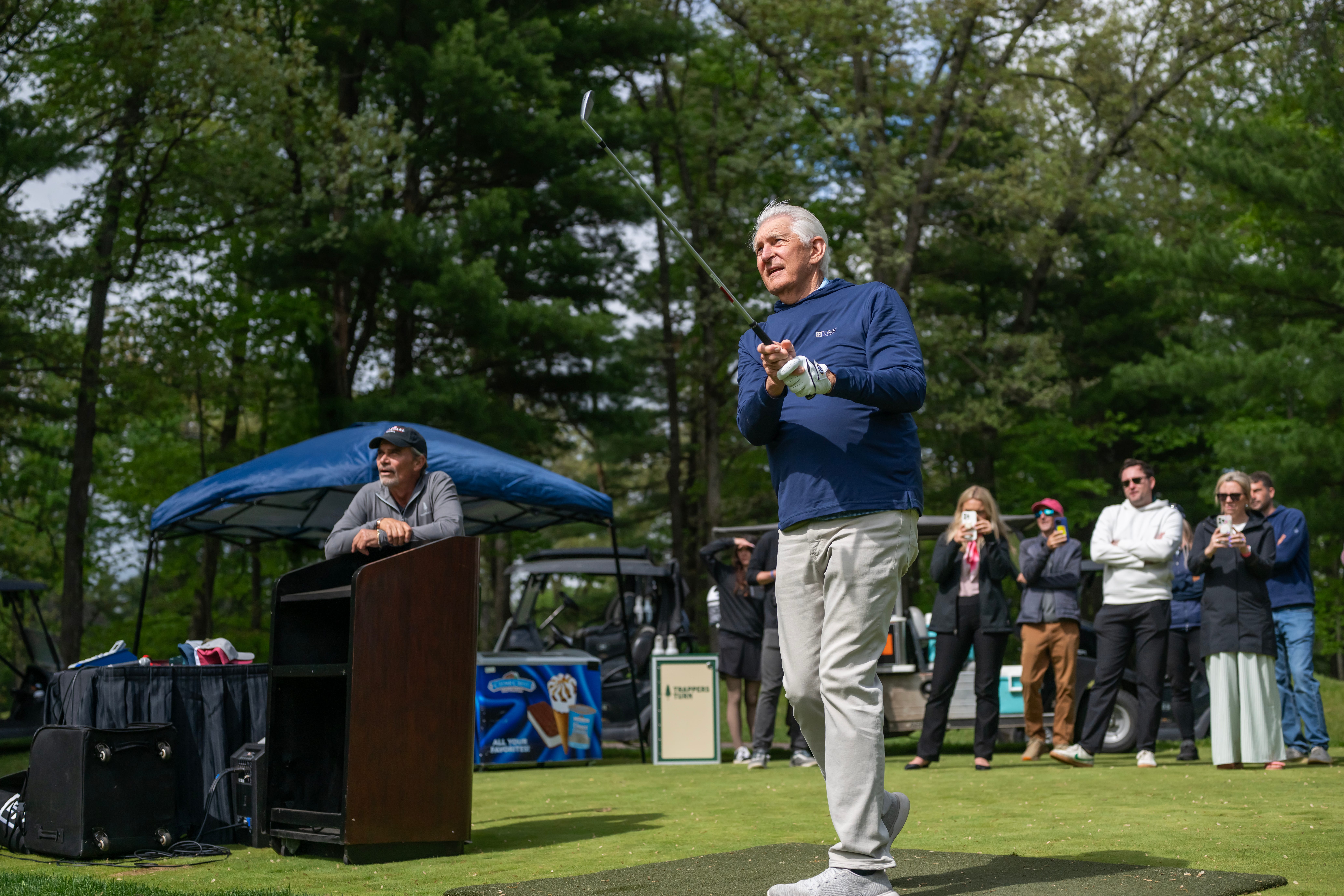
Two-time U.S. Open champion Andy North returned to Trappers Turn Golf Club on May 19 to hit one of the first shots into a reopened Canyon 7 — the signature hole he designed, and the centerpiece of a year-long renovation that has changed it beyond recognition.
For decades, the hole’s drama was hidden. Sitting deep in a natural sandstone canyon, the green was hemmed in by overgrown trees that starved it of sunlight and airflow and concealed the rock walls that made the setting extraordinary. The renovation cleared all of it. The glacier-carved sandstone — a defining feature of the Wisconsin Dells landscape — is now fully exposed and frames the green, the putting surface has been nearly doubled to close to 6,000 square feet, and new waterfall work sits behind a shot North describes as playing into a box canyon.
The reopening drew owner Todd Nelson, the project’s architecture team, and a crowd that included Wisconsin Dells Middle School golfers, who closed the afternoon with a “Beat Andy North” challenge on the new hole.
The timing is no accident. Canyon 7 caps a sustained run of reinvestment at Trappers Turn — from the Andy North-designed 12 North par-3 course to expanded practice and putting facilities — that has turned a well-regarded Wisconsin Dells course into a genuine destination. With three championship nines and a fully transformed signature hole, Trappers Turn enters the 2026 season in the strongest position in its history.
B. DRADDY DROPS NEW DRADDY SPORT STYLES FOR SS26
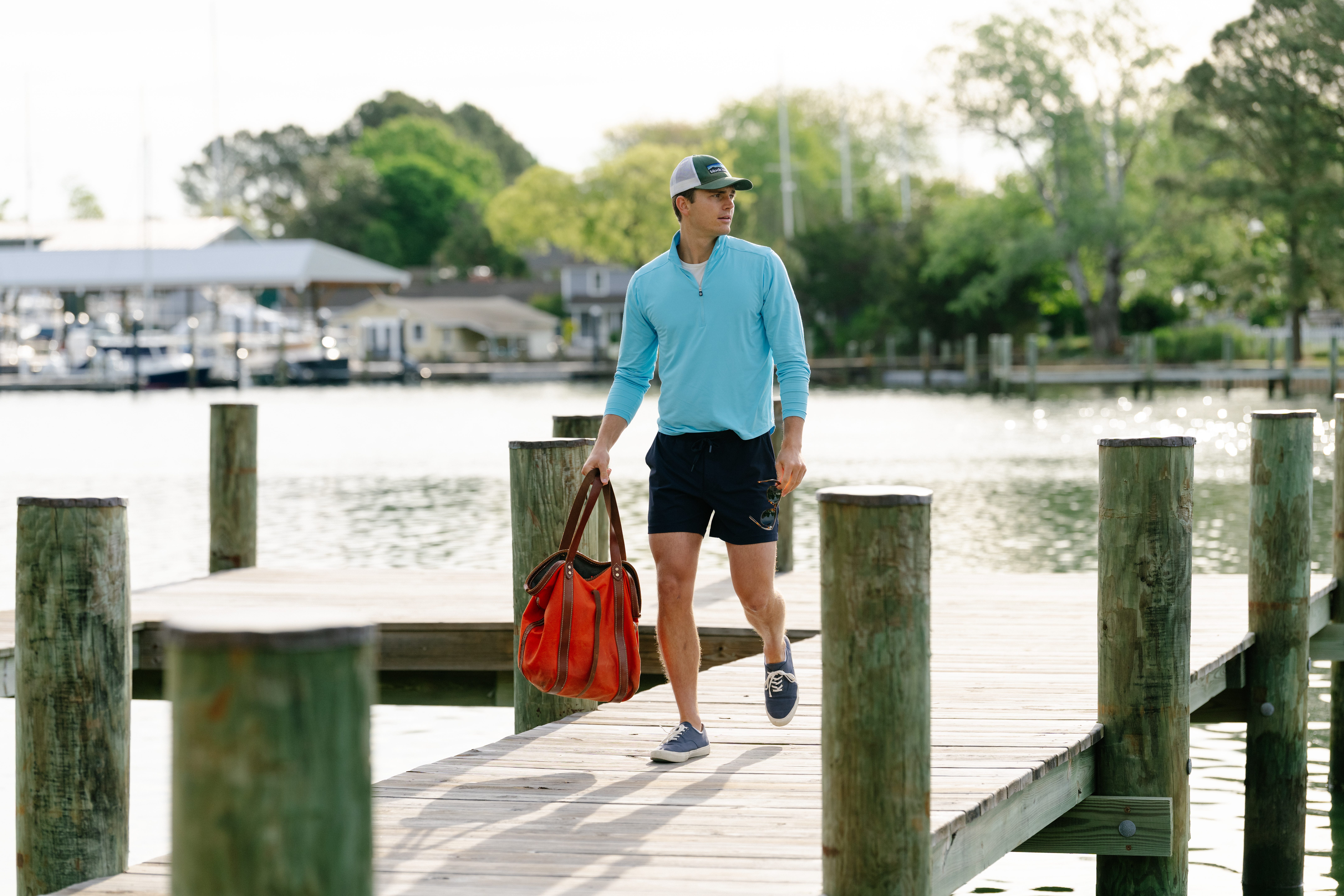
B. Draddy — the premium golf and lifestyle brand under the Summit Golf Brands umbrella — has expanded its Draddy Sport performance collection with new styles and colors for the 2026 season. The line covers polos, layers, and bottoms cut from the brand’s Cool Fabric™ jersey and a selection of Peruvian and Egyptian cottons, combining technical performance with the kind of comfort that carries through a full day on and off the course.
The timing is notable: B. Draddy heads into summer 2026 as the Official Uniform and Apparel Provider of the Presidents Cup and Official Uniform Supplier of the 2026 and 2028 U.S. Solheim Cup Teams — tour-level exposure that tends to move product in the pro shop. The SS26 collection is available now, starting at $120.
USGA PAIRS COMMUNITY INVESTMENT WITH FAN EXPERIENCE PLANS FOR 2026 U.S. OPEN AT SHINNECOCK
The USGA has outlined a broad community program tied to this week’s U.S. Open at Shinnecock Hills, with the aim of leaving a lasting impact across Eastern Long Island beyond championship week.
Working with the Metropolitan Golf Association and Shinnecock Hills Golf Club, the governing body will provide support to four Suffolk County public courses, Indian Island, Timber Point, Bergen Point, and West Sayville, through two years of agronomic consulting from the USGA Green Section to help improve course conditions, management practices, and long-term sustainability. The initiative will also expand youth golf opportunities within the Shinnecock Nation, including enhanced programming at the Shinnecock Nation Boys & Girls Club, while the USGA’s Pathways Discover program will return for a fifth straight year to give 24 college and graduate students from underrepresented backgrounds a paid introduction to careers in golf and sports business. USGA chief executive Mike Whan said the championship was an opportunity to invest in “the people, places and programs that make golf more accessible and sustainable across Suffolk County.”
That longer-term community focus will sit alongside an expanded on-site fan experience at Shinnecock. The USGA said spectators can expect a mix of technology, hospitality and interactive features including Rules AI with Deloitte, an Interactive Map powered by Cisco in the USGA app, GOLFZON simulators, the GHIN Putting Experience presented by Sentry, the Swing Experience Driven by Lexus, enhanced digital displays using ShotLink and Trackman data at the range, and a 34,000-square-foot merchandise pavilion carrying more than 500,000 items from 45 brands. Additional activations will include American Express cardholder perks, the Ally Bunker Challenge, T-Mobile member benefits, the return of the Lemon Wedge cocktail by DEWAR’S, Sun Cruiser’s 19th Hole, and a SeatGeek mural at the ticket entrance. USGA chief commercial officer Jon Podany said the goal was to ensure every fan experienced both the history of Shinnecock and “a modern, world-class championship experience.”
TORO SETS NEW 2030 TARGETS AS GOLF IRRIGATION SOFTWARE FEATURES IN SUSTAINABILITY UPDATE
The Toro Company’s fiscal 2025 Sustainability Impact Report puts a stronger emphasis on golf-related efficiency tools, with the clearest course-specific development being the launch of Toro Spatial Adjust, software designed to help golf facilities make more precise irrigation decisions by collecting thousands of moisture readings during routine mowing.
Toro said the wider report introduces new 2030 targets, including cutting direct operational emissions and emissions linked to purchased electricity by 15% from a 2025 baseline, while also committing to a 90% zero-waste-to-landfill diversion rate and continued sustainability checks in new product development. For golf and turf operators, the most relevant themes are the company’s continued expansion of autonomous and battery-powered equipment, a push toward more data-led resource management, and a broader focus on helping customers reduce engine emissions and improve labor efficiency.
Chairman and chief executive Richard Olson said Toro’s approach was centered on responsible practices and innovation, while the company said its 2025 progress also included battery recycling support across 48 U.S. states and wider operational improvements aimed at resource efficiency and lower waste.
GOLF CART MARKET FORECAST TO REACH $4.9BN BY 2033
The global golf cart market is projected to grow from $3.4 billion in 2026 to $4.9 billion by 2033, according to Persistence Market Research. Representing a 5.4% compound annual growth rate, the research shows that carts are becoming more widely used across golf courses, residential communities, resorts, commercial sites, and recreational venues.
The report says the strongest demand continues to come from small two-to-four-seat models, which account for 61% of the market, while golf clubs remain the leading product category with a 55% share. North America leads the market with 40%, supported by its large golf course base, mature recreational infrastructure and broader use of golf carts for personal transport, while Europe and Asia Pacific are also expanding as tourism, hospitality and leisure developments create new demand.
Persistence said growth is being driven both by golf and by broader uptake in private communities, resorts, event venues and commercial properties, with an incremental opportunity of $1.5 billion expected through 2033 as manufacturers respond with product innovation and efficiency improvements.
FIVE IRON GOLF OPENS 30,000-SQ-FT CORAL GABLES FLAGSHIP AS BRAND ENTERS FLORIDA
Five Iron Golf has opened its new Coral Gables flagship at The Plaza Coral Gables, marking the company’s first Florida location and its largest U.S. venue to date.
The 30,000-square-foot site includes 12 Trackman-powered simulators, instruction affiliated with the Jim McLean Golf School, Callaway Tour Fitting experiences, league play, memberships, and year-round access to virtual rounds on well-known courses.
Co-founder and chief executive Jared Solomon said Florida had long been one of the country’s most important golf markets, while venue owner and developer Peter McCormick said early demand showed golfers were looking for more flexible, technology-led ways to practice, improve and spend time around the game.
The venue is also tying into Women’s Golf Month by hosting Women’s Wednesday events throughout June in partnership with Legs Golf Miami.
GOLF SWING SYSTEMS JOINS INDOOR GOLF PARTNER IN EMEA EXPANSION MOVE
UK simulator specialist Golf Swing Systems has become part of Denmark-based Indoor Golf Partner, in a deal intended to strengthen the combined company’s position in the indoor golf market across Europe, the Middle East and Africa.
IGP, Trackman’s exclusive installation partner across the EMEA region, has completed more than 3,000 simulator installations over the past decade and is known for building premium indoor golf environments for residential, coaching and commercial use. The agreement is expected to expand Golf Swing Systems’ capabilities in simulator design, installation and customer support, while also giving the UK business access to wider technology and international resources. Founded more than 25 years ago, Golf Swing Systems has developed a strong presence across home simulators, coaching studios, golf clubs and entertainment venues, and both companies said they would now work together to deliver consultation, design and installation services across projects of varying size and complexity as demand for indoor golf continues to rise.
GRASS LEAGUE OPENS FRANCHISE PROCESS FOR TWO NEW TEAMS AHEAD OF 2027 SEASON
Grass League has opened applications for two new expansion franchises for the 2027 season, with the successful bidders becoming the 12th and 13th teams in the league.
The application window opened last Thursday (June 11th) and will remain open till September 1, with final selections expected by October 10 and public confirmation in December 2026. Chief executive Jake Hoselton said demand for franchises had exceeded expectations, with interest coming from private equity firms, family offices, high-net-worth individuals, athletes, golfers, celebrities and sports content creators, but said the league was seeking owners with financial strength, strong golf and local-market credibility, and a media-led approach to building audience and franchise value.
Grass League currently has a two-year broadcast deal with Golf Channel through 2027 and plans to expand its schedule, with its headline events, the Grass Clippings Open, Summer Grind and Grass League Championship, featuring purses of more than $150,000, a live draft and a franchise-based structure.
LIV GOLF ADELAIDE DELIVERS $97.1M ECONOMIC IMPACT FOR SOUTH AUSTRALIA
LIV Golf Adelaide 2026 generated a record A$97.1 million for South Australia’s economy, up almost 20% on the previous year, taking the tournament’s total economic contribution since launch to A$314.6 million.
The event, held at The Grange Golf Club from 12-15 February, attracted a record 115,000 spectators, up 12% on 2025 and 21% on 2024, with 43% of attendees traveling from interstate and staying an average of 3.71 nights, helping drive a record 10,895 hotel rooms occupied in Adelaide on 14 February 2026. The tournament also set a new national attendance benchmark for golf and produced the largest single-day crowd in LIV Golf history, with 38,500 on the Saturday, while fans also saw Ripper GC win the team title and Anthony Kim claim his first LIV Golf individual victory in the league’s new four-day, 72-hole format.
Premier Peter Malinauskas said the event had given the state “314 million reasons” to back major events, while LIV Golf executive vice president and head of events Ross Hallett said Adelaide continued to set a new standard for what a golf tournament could bring to a city; the event moves to Kooyonga Golf Club in 2027 before shifting to the redeveloped North Adelaide Golf Course in 2028.
ROCKET TO END TITLE SPONSORSHIP OF DETROIT PGA TOUR EVENT AFTER 2026
Rocket will not renew its title sponsorship of the Rocket Classic after the 2026 tournament, ending an eight-year run as backer of the Detroit PGA Tour event.
It may not be the end of tournament golf in the Michigan area, as the Tour is still expected to explore whether the market remains viable with a new sponsor. Industry sources said the event had been considered as a possible Track 1 tournament under the Tour’s proposed 2028 structure, but Rocket was not prepared to meet the $30 million-plus annual commitment believed to be sought for those events, with its existing full-field title deal estimated in the $15 million to $18 million range. Other factors are understood to have included differing views over venue strategy; Rocket wanted to keep the event at Detroit Golf Club in the city, while the Tour was open to a broader Detroit-area move, as well as wider corporate pressure, with Rocket’s share price down almost 38% year to date.
The company will remain an official marketing partner of the PGA Tour through the end of 2026 and could return in the future, while the tournament itself is now under new leadership with former Michigan State athletic director Mark Hollis succeeding Intersport. The wider decision comes as the Tour’s Future Competitions Committee nears the end of its work on the 2028 model ahead of a June 22 Policy Board meeting, with chief executive Brian Rolapp saying recently there had been “a lot of interest” from sponsors in both Track 1 and Track 2 events. Josh Carpenter, Sports Business Journal.
SCOTTY CAMERON ADDS PHANTOM 3.2 AND PHANTOM 12 TO 2026 PUTTER RANGE
Scotty Cameron has expanded its 2026 Phantom lineup with two new models, the Phantom 3.2 and Phantom 12, aimed at different player preferences within the mallet category and priced at $499.
The Phantom 3.2 is a compact mid-mallet with a “.2” plumbing neck for moderate toe flow, multiple alignment features including a Tri-Line sight line, T-Crown shaping and open rear windows, plus a full-face Studio Carbon Steel insert with chain-link milling to soften sound and feel while preserving ball speed.
At the other end of the range, the Phantom 12 is a larger high-MOI mallet with the deepest and lowest center of gravity in the Phantom family, achieved through a multi-material build using Space Gray aluminum in the face and mid-body and heavier stainless steel low and around the perimeter, with steel accounting for about 65% of total head weight.
It also uses chain-link milling, a long single sight line, T-Crown alignment, and a mid-single-bend shaft for minimal toe flow. The Phantom 3.2 right-handed model will be available from June 25, with the left-handed 3.2 and Phantom 12 following on July 23.
I cant wait …