


HOUSEKEEPING BEFORE WE START: Golf Business Review is made possible by the support of its readers and by carefully selected partnerships that sustain our independent editorial work. If you would like to support independent, long-term coverage of the global golf industry — and access the full GBR archive — subscribe here.
HOW TO PARTNER WITH US: If you are interested in contributing to and strengthening our content offering as a partner, company, or institution, we would be pleased to hear from you at newsroom@golfbusinessreview.com.
MANAGE YOUR SUBSCRIPTION: If you no longer wish to receive our emails, you can unsubscribe here.
Hello GBR,
Today’s edition of GBR introduces two new regular slots over the coming weeks. We take a look at the rise of Vietnam as a golf destination and why it is being considered as one of the top five global emerging markets for the golf industry. We’re also excited to introduce a regular feature from 59club, who will be sharing some key insights in what shapes the strongest member and non-member experiences that golf clubs should be paying attention to survive and thrive going forward.
We start with news from another partner of GBR, Summit Golf Brands, who are venturing out into news pastures to grow their business.
Enjoy today’s GBR and have a good weekend.
SUMMIT GOLF BRANDS PARTNERS WITH COOLMORE IN MOVE INTO THOROUGHBRED RACING
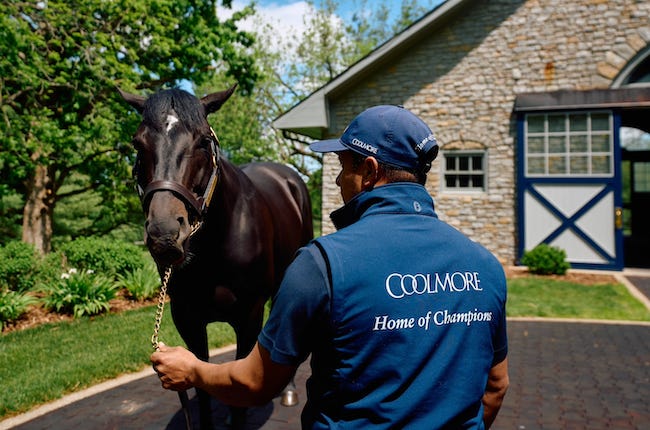
Summit Golf Brands, the parent company of B. Draddy and Zero Restriction, has signed a new partnership with Coolmore that names both labels as Preferred Apparel Providers to one of the best-known organizations in thoroughbred racing and breeding. The agreement extends Summit’s reach into horse racing and will see B. Draddy and Zero Restriction outfit members of the Coolmore and Ballydoyle teams, while also supporting the launch of custom co-branded apparel, online capsule collections, and on-site activations at major events, including the Kentucky Derby. Coolmore, based in Tipperary, Ireland, operates major international bases, including Ashford Stud in Kentucky, and has significant operations in Australia. It is known for standing American Pharaoh and Justify, the only two living U.S. Triple Crown winners, while its Ballydoyle training center in Tipperary has produced a record 18 Epsom Derby winners and continues to operate under trainer Aidan O’Brien. Summit Golf Brands president Jack Lessing said the partnership formalized a relationship that had developed naturally over time, while Coolmore sales director David O’Loughlin said the brand’s combination of versatility and quality made it a natural fit.
The companies said the relationship is based on shared values of heritage, innovation, and quality, with both organizations family-owned and positioned around premium performance. Summit framed the collaboration as a meeting point between luxury design and practical comfort, describing the apparel offer as suitable “from the horse to the course, and everywhere in between”. Coolmore said the deal would strengthen both team outfitting and merchandise, while also widening the reach of the new collection to supporters globally.
📄 Access the full press release here.
You can follow each brand on Instagram: @bdraddy, @zerorestriction, @coolmorestud, @summitgolfbrands
INTRODUCING 59CLUB’S CUSTOMER EXPERIENCE INSIGHT SERIES FOR GOLF BIZZ REVIEW
Golf Bizz Review is working with 59club to bring regular customer experience insight, practical education, and global benchmarking data to our readers, with a focus on the standards that shape how golf venues perform in the real world.
59club has become the leading specialist in golf customer service and sales analysis, helping clubs and resorts understand how their operations are experienced by members, guests, and prospective customers. Through mystery shopper feedback, global benchmarking data, and best-practice learning, 59club highlights where service standards are strongest, where opportunities are being missed, and how small improvements can make a measurable commercial difference.
This regular series will draw on 59club’s data and wider industry network to explore the details that influence the customer experience across golf and hospitality, from the entire golf visitor journey, including retail, food and beverage, and on-course engagement, to membership, event, and golf outing inquiry management.
This article focuses on the importance of first impressions, sensory experience, and the small details that influence customer loyalty.
The Senses And First Impressions
With the help of a range of industry experts, Matt Roberts, 59club Director, considers the role the senses play in customer service – and how powerful first impressions can be.
Reimagining golf clubs as health and business hubs
With changing lifestyles and working patterns, golf clubs now have the chance to play a much bigger role in people’s everyday lives, explain Gareth Beard and Dawn White, Senior Area Operations Managers at Bruntwood SciTech
Learning from hospitality
In our world, we’ve seen how spaces really come alive when they’re designed around people, not just function. That’s what the hospitality sector gets right. Golf clubs can build on this strength by creating destinations that are welcoming, social, and flexible with workspace, wellness facilities, quality food and drink, and a strong events program.
The power of experience
What sets places apart are the details that engage the senses, from music, lighting, biophilia, and scent, to service and design. At Bruntwood SciTech, this approach has helped us achieve a 70% customer retention rate – well above the industry average – and high customer usage of 71% across the week. For golf clubs, these small touches can create memorable experiences that encourage members to return and stay longer.
A good first impression is about making someone feel seen, respected, and valued right from the start. It’s a blend of subtle cues, actions, and attitudes that create an immediate positive impact. It will also include visual aspects within a workspace, social locations, and generally the place and space we interact with.
Research tells us that first impressions can be formulated in between seven and 27 seconds. They last long and are very hard to overturn, so it is important to focus on all areas that will influence and create the best first impressions.
During the inaugural 59club Global Awards, we were joined on stage by Gareth Beard and Dawn White, who are both Senior Operations Managers at Bruntwood SciTech, Ryan Woods, General Manager of Pinebrook Golf & Country Club, and Nic Middleton, Founder and Owner of Zen Putting Stage. They offered some insightful presentations from their own experience, and talked through various ways we can create better first impressions within all areas of hospitality.
59club data shows that venues that work on their first impressions – which include eye contact, smile, acknowledgment, welcome, and engaging conversation – will deliver a better experience over 13% more often than those that don’t, and the best in class deliver a nearly faultless first impression over 89% of the time.

Unlocking potential
Blending workspace with leisure and health offers golf clubs more than an additional service; it creates fresh reasons for midweek use, attracts broader audiences, and supports new revenue streams – all of which help secure long-term resilience. For the greatest impact, focus on the small details that engage the senses to create places people want to return to, and golf clubs can strengthen loyalty and their role as hubs for health, business, and community...
The senses in service
Ryan Woods, CEO of Pinebrook Golf & Country Club, explains that all five senses are crucial when it comes to making his members feel at home
In our service world, data tells one story, but experience tells the human side. I was fortunate to share some of what makes Pinebrook a special place in our recent presentation on The Power of Scent in Enhancing the Member Experience: A Journey Through the Five Senses. I view training and the service we offer as more than a checklist – it’s a framework for shaping how members feel the moment they arrive and how long that feeling lingers. Scent is one of several key focus areas we pursue to move beyond transactions into lasting connections.
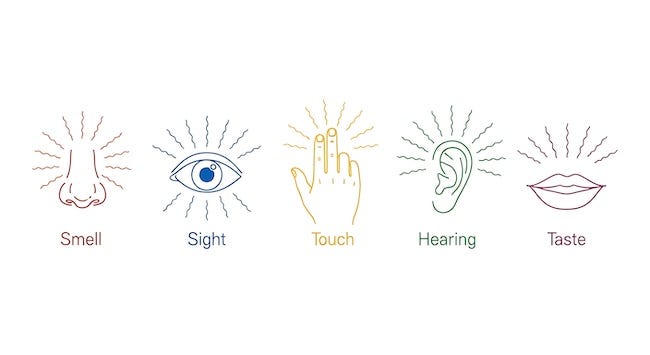
First, the five senses aren’t just signals; they’re levers for emotional engagement. Sight, sound, scent, touch, and taste each contribute to a club’s identity, shaping memories of a visit long after the round is done
Second, the clock speed of modern service, speed, and efficiency matter, but it’s the anticipation, warmth, and care that convert visits into loyalty.
Third, the “Proust effect” – where small sensory cues trigger personal memories – drives repeat engagement when we get the details right.
At Pinebrook, we’re translating these insights into culture. We train staff to read rooms, respond with genuine care, and lean into a hospitality-forward mindset – not a rule-based checklist. It’s about creating a vibe where staff-led conversations feel meaningful, and where every touchpoint – from the pro shop to the grill – feels intentional. The power of scent marketing goes a long way toward making our members feel at home.
The short-term wins are real and notable: higher satisfaction scores, more repeat visits, and stronger word-of-mouth. The long-term payoff is a club that people leave wanting to return to, again and again.
Sensory design isn’t decoration; it’s a strategic tool to forge emotional resonance, drive loyalty, and elevate any club from a great club to a truly memorable experience. While we tend to focus on the key areas around the club – the sights and smells – we can go beyond that to curate an experience that continually evolves and engages our members in unconventional, impactful ways.
Unlocking the untapped potential of putting
Nic Middleton, Founder and Owner of Zen Putting Stage, explains how putting should be at the center of all golf leisure environments
At the inaugural 59club Awards, Zen Golf delivered a thought-provoking presentation exploring how the senses underpin skill acquisition in golf and how a deeper understanding of them can transform customer experience.
Using the striking image of a sensory homunculus, the presentation highlighted often-overlooked senses such as balance, proprioception, and kinaesthetic awareness, showing how they shape a golfer’s interaction with the course and its facilities.
Drawing on recent data, Zen proposed that golf venues are overlooking one of their most powerful assets: putting. Despite its central role in performance, putting remains underdeveloped as an engagement tool.
Zen argued that by focusing on this untapped resource, operators could deliver significant performance enhancement while opening new avenues for customer loyalty, dwell time, and incremental revenue.
The presentation showcased how Zen’s Green Stage Adaptive Terrain Technology (ATT) has been combined with ball-tracking systems and gamification strategies, underpinned by the latest scientific skill acquisition framework of ecological dynamics.
This approach turns putting into an interactive, game-like experience that is both entertaining and educational. Visiting parties, members, and guests can be drawn into experiences that feel fun yet purposeful, fostering skill improvement while strengthening emotional ties to the venue.
Zen’s message was clear: re-imagining putting as an immersive, sensory-rich experience offers operators a powerful way to differentiate, delight customers, and build repeat business. For a sector seeking fresh ways to engage today’s golfer, the future of participation and loyalty may start on the green.
59club helps clubs see their operation through the eyes of members, guests, and prospective customers, and turn that insight into measurable improvement.
For golf venues looking to better understand their customer journey, improve service standards, and identify the small details that drive loyalty, 59club’s data-led approach offers a practical starting point.
To learn how 59club can support your venue, contact the 59club team here: https://www.59club.com/
News In Brief
Troon International has launched Troon International Travel, a curated global golf travel platform developed with golfscape to give golfers direct access to premium destinations and tailored stay-and-play experiences across Europe, the Middle East and Asia.
Powered by golfscape booking technology, the platform allows golfers to select destinations, tee times and accommodation through a three-step booking process with real-time availability, instant confirmation and mobile-first functionality.
Five Iron Golf has announced the return of its annual Women’s Golf Month initiative, a June campaign now in its third consecutive year, presented with Golf Digest and focused on making golf more welcoming, social and accessible for women of all experience levels.
Participating locations nationwide will offer up to 90 minutes of free golf for women every Wednesday, $5 first-month memberships, free swing evaluation lessons, beginner-friendly instruction, community nights and networking opportunities, with Five Iron also partnering with women-led golf groups including Ladies Who Golf, Cherry Golf Club, She Golfs ATL, Girls on the Green Golf Network and Fore the Ladies.
VIETNAM’S GOLF ECONOMY IS STARTING TO LOOK SERIOUS
For years, Vietnam sat in the same category as many emerging golf destinations: attractive climate, ambitious resort projects, a handful of good courses, and periodic predictions that it would become “the next big thing.” Golf has heard that story before.
What feels different now is that Vietnam is beginning to develop the characteristics of a genuine golf economy rather than simply a golf tourism market.
That distinction matters.
Golf tourism alone can create short bursts of attention. A golf economy is broader and more durable. It begins to pull together hospitality, infrastructure, real estate, international branding, manufacturing, aviation, technology, and investment into a connected commercial ecosystem. The most important thing about Vietnam today is not that it has some impressive golf courses. It is that multiple parts of the global golf industry are quietly starting to position themselves around the country at the same time.
The momentum is no longer theoretical.
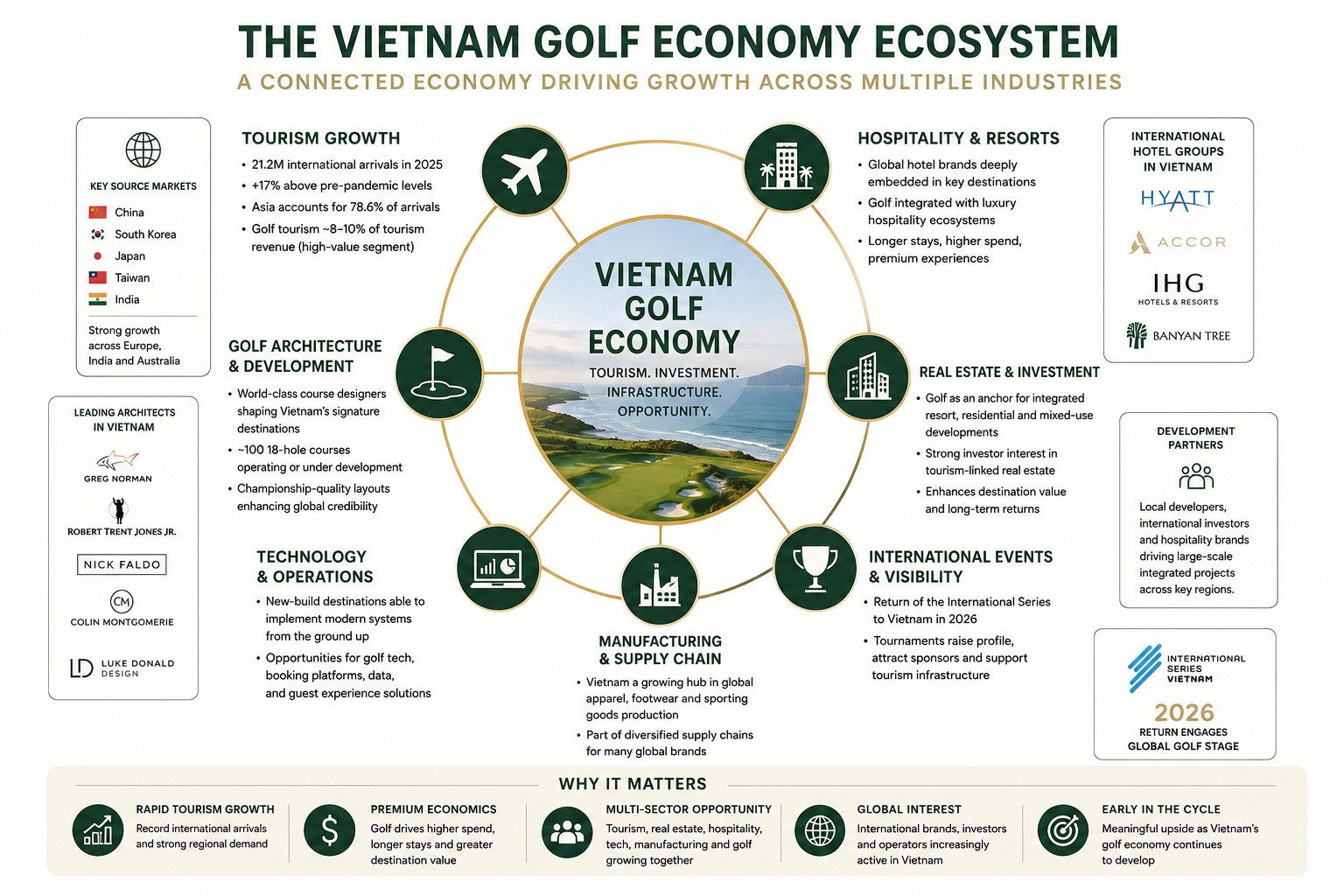
Vietnam welcomed nearly 21.2 million international visitors in 2025, a record figure and more than 17% above pre-pandemic levels, according to the Vietnam National Authority of Tourism. The wider tourism sector has become one of the country’s major economic growth engines, with domestic travel also surging and international arrivals now heavily concentrated around Asian source markets such as China, South Korea, Japan, Taiwan, and India.
That matters because those markets already underpin much of Asia’s premium golf-travel economy.
Vietnam itself does not appear to publish a definitive national figure for inbound golf tourists, but the broader travel numbers help explain why golf developers and operators are increasingly focused on the market. Golf tourism has become valuable not because it delivers mass participation, but because it attracts higher-spending visitors into luxury hospitality ecosystems. Several estimates now place golf tourism at roughly 8–10% of Vietnam’s total tourism revenue despite accounting for a far smaller share of total visitor numbers.
That imbalance is commercially significant.
Golf tourists tend to stay longer, spend more, and travel through premium hospitality channels. For developers and operators, golf is often less important as a standalone business than as a mechanism for supporting hotel occupancy, resort positioning, and real-estate value.
That model is becoming increasingly visible across Vietnam.
The country now has close to 100 18-hole golf courses either operating or under development, according to industry estimates, with a growing number built to international championship standards. Central Vietnam, particularly the Danang–Hoi An corridor, has emerged as the clearest symbol of that growth. In many ways, the region now resembles the type of destination clustering that helped transform parts of Portugal or Spain into internationally recognized golf hubs.
The difference is that Vietnam still feels early in the cycle.
Fifteen years ago, Vietnam barely registered within mainstream golf-travel discussions outside specialist circles. Today, it increasingly appears in conversations around Asia’s fastest-growing golf destinations, long-haul premium tourism, and emerging hospitality investment.
Part of the attraction lies in geography.
Vietnam sits inside one of the most commercially important tourism corridors in global golf. South Korean outbound golf travel remains one of the strongest segments in Asia, while Japanese, Taiwanese, and broader Southeast Asian tourism continues to expand. Vietnam increasingly benefits from all three simultaneously. It is accessible, comparatively affordable at the premium end of the market, and still carries a degree of novelty for international golfers looking beyond more established destinations.
That “newness” has value.
Golf tourism, particularly at the higher end of the market, relies heavily on differentiation. Scotland and Ireland continue to dominate the traditional bucket-list market globally, while Spain and Portugal remain established European winter destinations. But affluent golfers increasingly look for locations that feel less saturated without sacrificing course quality or hospitality standards. Vietnam is beginning to occupy that space.
Danang demonstrates this especially well.
The region now offers a concentration of high-quality golf courses, beach resorts, and integrated hospitality infrastructure capable of supporting multi-course destination trips in a relatively compact area. Courses such as Hoiana Shores, Ba Na Hills Golf Club, Laguna Golf Lang Co, and Montgomerie Links have all contributed to changing external perceptions of Vietnam from an emerging golf destination into a serious one.
The quality of the architecture is also important.
Vietnam has spent the past decade aggressively pursuing internationally recognizable course designers, including Greg Norman, Robert Trent Jones Jr., Nick Faldo, Colin Montgomerie, and Luke Donald. That matters commercially because destination golf is ultimately a branding exercise as much as a sporting one. Recognizable names help legitimize projects internationally, attract affluent traveling golfers, and create visibility within global golf media.

The hospitality side of the equation may be even more revealing.
Groups such as Hyatt, InterContinental, Accor, and Banyan Tree are already integrated into Vietnam’s luxury tourism infrastructure, particularly across central Vietnam. Golf increasingly sits alongside those hospitality ecosystems rather than operating separately from them. In practical terms, that changes the economics of golf development entirely.
The scale of international interest is also becoming more visible.
One of the clearest examples came through the Trump Organization’s reported $1.5bn golf, hotel, and real-estate project in Hung Yen province in northern Vietnam, alongside local developer Kinhbac City. Reuters reported that the project received approval in 2025, with the first golf courses expected to open by mid-2027.
Regardless of political views attached to the Trump brand, the project matters because it underlines how Vietnam is increasingly being viewed as a platform for branded golf, hospitality, and real-estate development rather than simply a tourism destination.
It also serves as a reminder that rapid golf expansion rarely arrives without complications. Reporting around land-use concerns and local opposition linked to the development illustrates some of the tensions that can accompany large-scale resort projects in emerging markets.