

The Competitive Range: How the Inrange World Tour Is Driving Business Results
Range golf is becoming a sport. Here is what that means for the facilities powering it.



There is a tension at the heart of every driving range. The golfers who show up most often — the avid players, the ones who keep the lights on — are also the ones most likely to find the experience flat. They practice. They hit balls. They leave. The range does its job, but it rarely captures the thing that makes golf on the course genuinely compelling: the feeling of competition, of being measured against someone else, of having something at stake.
That gap is what Inrange has spent the last three years building a solution to. And Season 3 of The Inrange World Tour — going live May 1st, next week — is the clearest, most commercially developed version of that solution yet.
What the World Tour is
The Inrange World Tour is the world’s biggest range golf competition. It runs across 85+ venues in 17 countries within the Inrange Partner Network, and the format is deceptively simple: monthly six-hole contests played virtually on world-class courses such as Le Golf National (host of the 2024 Paris Olympics), Gleneagles (host of the 2014 Ryder Cup), and the iconic Pebble Beach.
This is not a casual leaderboard bolted onto an existing product. It is a structured, global competition with divisional scoring, promotion and relegation, and an invitation-only elite tier. And it sits entirely within the Inrange infrastructure already installed at every partner venue. Operators do not program it, staff it, or promote it independently. It runs, and with it comes a recurring, structured reason for players to return.
Season 2 recorded a 4.5x increase in participation over the debut year. Season 3 is built to go further.
What is new in Season 3 — and why it matters for operators
Three additions define this edition, each deepening the business case for the facility.
Divisional scoring gives every player — from scratch to 28-handicap — a genuine path to winning their division, with a dynamic promotion and relegation model that recalibrates continuously.
Tour Elites introduces an invitation-only tier for the top performers across Inrange’s full network, turning a facility’s most engaged regulars into the faces of range golf as a competitive sport.
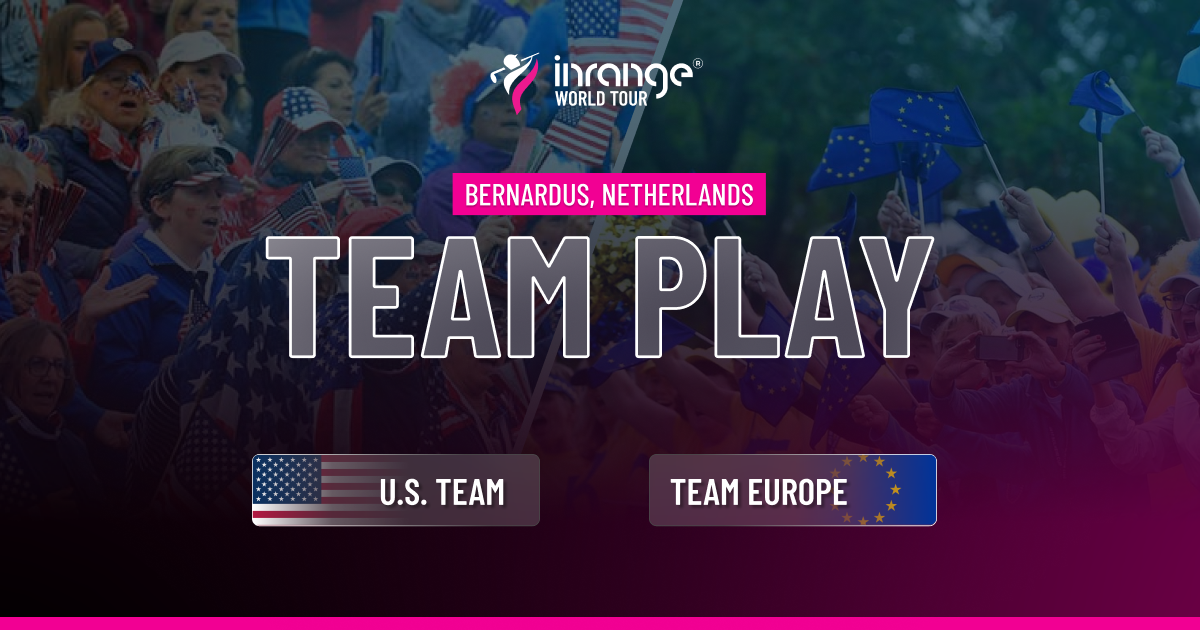
The headline addition for Season 3, however, is the Solheim Cup activation — and for operators targeting group and social business, it is the most commercially significant move yet.
During a portion of the tour, players declare allegiance to Team Europe or Team US, competing across three rounds where individual scores also count toward a collective team result. This is not just a competitive format — it is a social one. Players join groups, compete together, and return as teams. Social golfers playing together means more players per visit, longer dwell times, and a direct boost to bay usage and food and beverage spend. It is, in short, another revenue generator that the venue does not have to plan, staff, or promote.
The activation is anchored to Bernardus Golf in the Netherlands — the host venue for the 2026 Solheim Cup this September, which Inrange Golf is currently precision-scanning into its software. Bernardus is a Kyle Phillips-designed championship course that has hosted the DP World Tour’s Dutch Open three consecutive years and is now preparing for one of the largest women’s sporting events in the world. Players at any Inrange venue anywhere on the planet will be able to compete on it.
For operators focused on attracting groups — corporate events, league nights, social rounds — structured team competition is one of the most reliable levers available. The World Tour delivers it automatically, without any additional effort from the facility.
The operator equation
The Inrange World Tour does something most engagement tools cannot: it gives every type of golfer a reason to come back on a schedule that the venue does not have to manage. The avid player returns to defend a division placing. The social golfer returns to contribute to their team’s score in the Solheim activation. The competitive player returns to chase a monthly leaderboard that resets and renews the stakes.
The results speak for themselves:
“The Inrange World Tour has elevated the experience at The Range at Clermont National by turning practice into competition. It’s created a more engaging, social environment that keeps players coming back more often and has had a direct impact on driving increased bay usage and overall revenue.”
— Jimmy Stewart, Owner & Operator of Clermont National, GRAA Winner.
Inrange describes its ambition as making range golf a standalone sport — with its own tours, its own majors, its own competitive infrastructure. The Inrange World Tour is the engine of that ambition. For operators who have the technology installed, that ambition is already delivering results. For those who do not, the gap is becoming harder to ignore.
Season 3 goes live on May 1st.
More info: The Inrange World Tour.
Find 85+ venues in 17 countries within the Inrange Partner Network.