

GBR | What Members Really Want From Your Golf Club Isn’t What You Think — 59club Data Reveals Why
Connecting the dots across golf’s business, media, and professional landscape

Hello GBR,
Welcome to Wednesday’s edition, and we have a bumper lineup for you to enjoy.
We start with an interesting insight report from our friends at 59club US. Membership sales are often discussed and executed; the importance is obvious. More members offer the potential to bring in more revenue, but is purely doing a hard sell on the club and course the right way to tug at the heartstrings of potential members?
59club US’s research suggests otherwise, and their findings make for an interesting read.
Old Tom Capital has released a fantastic new report, 2026 Golf Industry Outlook. There’s some fantastic insight delivered in the full report, and it’s well worth downloading.
Our two headline stories are joined by stories from Five Iron Golf, Indoor Golf Alliance, Persistence Market Research, and 8AM Golf, to name a few more.
Enjoy today’s newsletter, speak Friday.
59club US Insight: Why Most Golf Clubs Lose Prospective Members Before The Sale Even Begins
Membership sales remain one of the most important, and often misunderstood, drivers of a golf club’s commercial performance, underpinning not just subscription income but long-term engagement and secondary spend. Yet despite this, many clubs continue to lose prospective members through inconsistent or poorly executed sales inquiry management.
59club has become the leading brand across golf, helping clubs understand how their service and sales standards perform in the real world, using mystery shopper feedback and global benchmarking data to highlight where membership inquiry processes can be improved.
Drawing on that insight, a clear pattern emerges: the gap between average venues and top-performing “Podium” clubs is not defined by facilities or price, but by the consistency of core sales behaviours. Understanding what those behaviours look like, and how they are applied in practice, is where the real opportunity lies.
59club explores this in the article below, showing why effective membership sales depend as much on understanding people as they do on promoting the club itself.
What members of your club really want is to feel a sense of belonging. 59club data can help you to understand how to create it...
That desire to feel connected and accepted is a fundamental part of human nature. In fact, it’s one of our most important psychological needs.
Every day around the world, golf clubs receive enquiries from prospective members attracted to the club with the desire to fulfil the same three needs: meet new people, participate in a sport, and join a community.
Membership sales is as much about helping prospects to identify what network they will align with, and what opportunities exist for them to integrate into club life, as much as it is about promoting the golf course and other attributes.
Global data collected from mystery shopping the membership sales process in 2024 throws up some very interesting insights around the industry’s ability to understand a prospective member’s needs to ‘sell’ the idea of belonging within the club community.
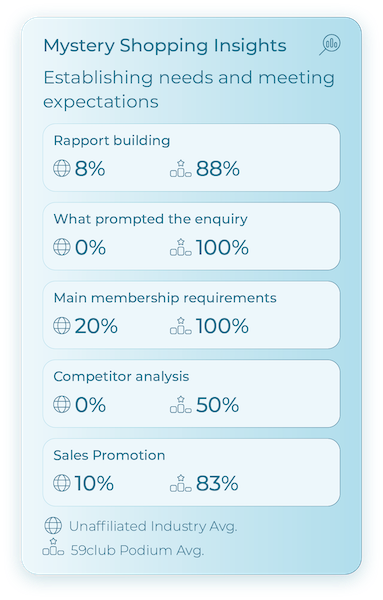
Membership is not a one-size-fits-all proposition; each member comes with a unique set of circumstances and will feel fulfilled by different experiences. Ultimately, it’s the task of the Membership Sales Advisor to remain focused when liaising with prospective members, actively listening to identify the individual needs of the person in front of them.
Once those needs are established, you are in a strong position to relate the club and its community to exceed the prospects’ expectations. This process will enhance new member conversion rates and breed loyalty within your club – and its community.

If you are a club manager or committee member looking to understand where your golf club’s opportunities lie, reach out to 59club for tailored expert support.
OLD TOM CAPITAL REPORT SAYS GOLF’S INVESTMENT CASE IS BROADENING
Old Tom Capital has released its 2026 Golf Industry Outlook, arguing that golf is entering a new phase of institutional interest as participation, technology, media, hospitality and real-asset ownership converge around a broader sports investment market. The report says the global sports economy is worth $2.5 trillion and could reach $3.7 trillion by 2030, while sports assets have compounded at 13.1% annually over six decades.
For golf specifically, it points to 549.5 million U.S. rounds played in 2025, the fourth all-time record in five years, with every year since 2020 above 500 million rounds despite around 2,000 fewer facilities than during the previous boom. It also says total U.S. participation has reached 48.1 million, with 29.1 million on-course golfers, 37.9 million off-course participants, 14.9 million core golfers and private club membership up 50% since 2019 to 2.1 million golfers.
The report identifies six investment categories it believes will shape golf’s next cycle: off-course and “Golf Lite” formats, infrastructure and technology, media and content, performance and equipment, sustainability and agronomy technology, and hospitality and travel. Among the standout data points, it says screen golf grew 13% in 2025 to 9.2 million players, 81% of facilities have still not adopted simulator technology, and the golf simulator market is approaching $2 billion globally.
It also highlights golf tourism as a major growth area, estimating the market at about $28 billion in 2025 and projecting it to exceed $60 billion by 2034, while St Andrews is cited as generating £317 million in annual economic value for Scotland. Old Tom Capital says the central opportunity is not simply adding more golfers, but converting interest into long-term engagement through better formats, technology, hospitality and operating infrastructure.
GOLF EQUIPMENT MARKET FORECAST TO RISE FROM $8.9BN TO $12.9BN BY 2033
The global golf equipment market is forecast to grow from US$8.9 billion in 2026 to US$12.9 billion by 2033, a 5.4% CAGR, supported by sustained post-pandemic participation growth, faster adoption of advanced equipment and expanding golf infrastructure in emerging economies.
The findings form part of a new report from Persistence Market Research, which also highlights North America remaining the largest region, with a 42% market share in 2025, helped by more than 41 million golfers in the U.S., higher disposable income and established retail and golf course networks.
Asia Pacific is the fastest-growing region, led by infrastructure investment in China, South Korea and Southeast Asia, while golf clubs remain the dominant product category with a 45% share in 2025, driven by higher prices, frequent upgrades, AI-led design and demand for custom-fitted equipment. Online distribution is the fastest-growing sales channel, helped by e-commerce, direct-to-consumer strategies and younger golfers’ buying habits.
The report says growth is being driven by a broader player base, including 66.6 million golfers across 208 countries globally, alongside rising demand for adjustable drivers, multi-material irons, smart-sensor embedded balls, AI-optimised clubfaces, high-speed ball technologies and fitting systems using platforms such as TrackMan and Foresight Sports.
Cost remains a barrier, with entry-level club sets from established brands typically priced between US$300 and US$700, while premium sets can exceed US$3,000, before course fees, apparel, footwear and accessories are added. Infrastructure is also unevenly distributed, with more than 75% of the world’s 38,864 golf facilities located in just 10 countries. The strongest opportunities are expected to come from indoor golf and entertainment venues such as Topgolf, Drive Shack and PopStroke, home simulators from brands including SkyTrak and Full Swing, and the women’s and junior markets, with women accounting for around 25% of U.S. golfers in 2023 and juniors exceeding 3.4 million on-course participants.
8AM GOLF JOINS MCLAREN GOLF AS NEW IRON LINE LAUNCHES IN MIAMI
8AM Golf has become an “investor, partner and advisor” to McLaren Golf, which launched last Wednesday ahead of the Miami Grand Prix and the PGA Tour’s Cadillac Championship at Trump National Doral.
8AM Golf, based in Scottsdale, owns or backs golf businesses, including Golf Magazine, Golf.com, Miura Golf, True Spec Golf, Payntr Golf, Club-Conex, Fairway Jockey, 3’s and Bounty Club, the Nashville course project created with Justin Timberlake. “It’s been two years in the making,” said 8AM Golf CEO and president Hoyt McGarity, while McLaren Golf CEO Neil Howie, formerly president and managing director of Callaway Golf Europe, said the company had challenged “every part of the process – from materials to construction” before bringing the irons to market.
McLaren Golf’s first products, the Series 1 and Series 3 irons, have been developed with Justin Rose, the company’s headline golf ambassador, who put a mixed set of Series 3 long irons and Series 1 mid and short irons in play at last weekend’s Cadillac Championship. McLaren has also announced that Michelle Wie West and Ian Poulter will also be brand ambassadors going forward. More details were released about the construction process, which is highlighted by Metal Injection Molding, a complex process rarely used at scale in golf and forms part of the reason for the eye-catching pricing ($375 per iron for both models), which McLaren Golf says allows tighter control over material composition, internal geometry and mass distribution than traditional forging or casting.
NGCOA LAUNCHES 2026 MEMBER GOLF STUDY TO BENCHMARK COURSE PERFORMANCE
The National Golf Course Owners Association has launched the 2026 NGCOA Member Golf Study, a new financial and operational benchmark report available at no cost to participating NGCOA members.
Developed with Greenlight Advisors and powered by the GolfClubBenchmarks.com platform, the study is designed to help golf course owners and operators compare their performance against aggregated peer data across areas including operational efficiency, labour costs, revenue per customer, food-and-beverage margins and capital expenditure.
Participating courses will receive two deliverables: a Best-in-Class Report Card™, using a top, median and bottom quartile framework, and the NGCOA Golf Study Benchmark Report, featuring member averages and wider industry comparisons.
The platform is built around four performance pillars: Financial Performance, covering revenue, costs, profitability and efficiency; Operational Performance, including rounds played, utilisation and staffing efficiency; Capital Asset Stewardship, assessing investment, maintenance and long-term infrastructure sustainability; and Player Experience, measuring satisfaction, loyalty, recommendation strength and engagement.
NGCOA members will receive confidential data aggregation, comparisons by state, region, nation and segment, including municipal, public-daily fee and resort courses, as well as early positioning for the wider 2026 U.S. Golf Study rollout later this year. “It gives members a dashboard with warning lights for their own operation,” said Rachel Carter, NGCOA Senior Director of Membership.
FIVE IRON GOLF OPENS FIRST CONTINENTAL EUROPE VENUE IN VALENCIA
It’s been a busy couple of weeks for Five Iron Golf. Last week, they launched their first venue in Saudi Arabia in the PIF Tower, Riyadh, followed by the launch this week of Five Iron Golf’s first location in continental Europe in Spain.
Five Iron Golf Valencia, operating at Calle Antiga Senda de Senent, had a soft opening on April 23, followed by the public opening on Tuesday (May 4), with the grand opening event on May 27. The approximately 10,700-square-foot venue combines golf, hospitality and entertainment, featuring eight Trackman-powered simulators, F1 racing simulators, VR darts and multisport games, alongside a full-service bar and kitchen.
The site can host up to 200 guests and is targeting casual players, experienced golfers, corporate events, networking groups, birthdays, children’s parties and private bookings. “As our first location in continental Europe, this opening is an important milestone for us,” said Jared Solomon, Five Iron Golf CEO and Co-Founder. Victor Amarnani, CEO of Five Iron Golf Iberia, said early demand for events, group bookings and memberships had been strong, particularly from Valencia’s corporate and expat communities. The opening forms part of Five Iron’s wider expansion across Spain and Portugal, with Madrid among the additional locations planned.
INDOOR GOLF ALLIANCE WEBINAR TO FOCUS ON FILLING EMPTY SIMULATOR BAYS
The Indoor Golf Alliance will host a free webinar on Wednesday, May 13, at 12 pm ET titled “Fill Empty Bays and Stay Connected with Your Golfers,” aimed at helping simulator facilities increase usage during slow hours and off-season periods.
The session will cover strategies for keeping bays occupied, maintaining customer engagement between visits, and using collaboration tools to create recurring revenue through coaching programmes. The webinar will be hosted by Phil Immordino, President of the IGA, with panellists Alex Berlin, Vice President of Operations at CoachNow, and Noah Hortsman, Owner and CEO of The Golf Garage in Medford, Oregon. Berlin will discuss how coaches and facilities can use technology to improve operations, revenue and player experience, while Hortsman will share examples from an indoor training and simulator business built around structured, data-driven instruction, year-round coaching and measurable player development.
If you are interested in registering to attend the webinar, you can contact Phil Immordino directly at phili@indoorgolfalliance.org.
KESWICK HALL TO HOST 2026 U.S. OPEN LOCAL QUALIFIER AT FULL CRY
Keswick Hall’s Pete Dye-designed Full Cry at Keswick Club will serve as a local qualifying site for the 2026 U.S. Open Championship on May 12, continuing the Virginia Wine Country resort’s run as a U.S. Open qualifying venue after hosting in 2023, 2024 and 2025.

The 18-hole qualifier will feature 84 players competing for five places in final qualifying for the 126th U.S. Open, which will be played at Shinnecock Hills Golf Club from June 18-21. Full Cry was enhanced in 2025 by Love Golf Design architect Scot Sherman, a longtime Pete Dye disciple, with updates designed to modernise the course while preserving Dye’s original strategy. “The routing forces you to think strategically on every single shot,” said Keswick Hall touring professional Lauren Coughlin. Full Cry will also host the Southern Amateur Qualifier, Middle Atlantic PGA Senior Championship, Senior Open of Virginia and University of Virginia Women’s Collegiate Event in 2026, and is ranked No. 94 on GOLF Magazine’s Top 100 Courses You Can Play in the U.S., No. 4 in Golfweek’s Best Courses You Can Play in Virginia and No. 58 in Golfweek’s Top 200 Resort Courses.
JON RAHM REACHES DP WORLD TOUR AGREEMENT OVER LIV GOLF FINES
Jon Rahm has reached an agreement with the DP World Tour to pay all outstanding fines linked to his LIV Golf appearances, clearing the way for him to return to the circuit and remain eligible to qualify for the 2027 Ryder Cup.
The fines were believed to total about $3m (£2.21m), and Rahm had announced in March that he had withdrawn his appeal against the sanctions. The DP World Tour said the agreement covers conditional releases for Rahm to play in conflicting LIV Golf events for the rest of the 2026 season, alongside payment of all fines accrued from 2024 to date and participation in agreed DP World Tour tournaments outside the majors later this year.

“There were some concessions on both sides,” Rahm said ahead of LIV Golf Virginia. “That will not be a stress anymore.” The 11-time DP World Tour winner had previously criticised the process, accusing the Tour of “extorting” LIV players, but his arrangement is understood to match the terms already accepted by eight others, including Tyrrell Hatton and Tom McKibbin.
O’NEIL SAYS LIV GOLF TEAM VALUE WILL DRIVE NEXT PHASE AFTER PIF FUNDING EXIT
LIV Golf CEO Scott O’Neil has said the league’s future value lies in its 13 teams, in his first public comments since Saudi Arabia’s PIF confirmed it will stop funding the league after the 2026 season.
Speaking ahead of LIV Golf Virginia at Trump National Golf Club, Washington, D.C., O’Neil said LIV believes its franchises can become highly valuable once the business has the right revenue base, cost structure and direction. LIV executives previously outlined a target of building each team toward a potential $1bn valuation, while the league had already been exploring minority investment in some teams at around $300m valuations, with Citi’s sports advisory group involved.
LIV currently owns 75% of each franchise, while team captains hold the remaining 25%, including Bryson DeChambeau’s Crushers GC and Jon Rahm’s Legion XIII, although no team investment deals have yet been completed. The league said Monday it had appointed Ducera Partners as investment banking adviser, following the creation of a new independent board led by two restructuring specialists. O’Neil said it had been clear “18 months ago” that LIV needed “significant and substantive changes” to become a going concern, but added: “I have a lot of confidence that this is a place players want to be.”
David Rumsey’s article featuring the interview with LIV Golf CEO Scott O’Neil can be read here.
ODYSSEY LAUNCHES DAMASCUS MILLED SEVEN PUTTER IN ULTRA-PREMIUM RANGE
Odyssey has moved further into the ultra-premium category with the limited-edition Damascus Milled Seven DB, priced at $699 and available from yesterday (May 5th), alongside the Damascus Milled Seven CH variant.
The putter combines Odyssey’s established Seven mallet shape with a forged, layered Damascus steel insert, where each face features a unique pattern and is engineered using AI-designed back contours to help maintain consistent ball speed across the hitting area. The head is fully milled from stainless steel, a construction aimed at delivering tighter manufacturing tolerances, cleaner shaping and a more refined feel compared with cast alternatives, while a blasted silver finish gives the putter a muted, high-end aesthetic.
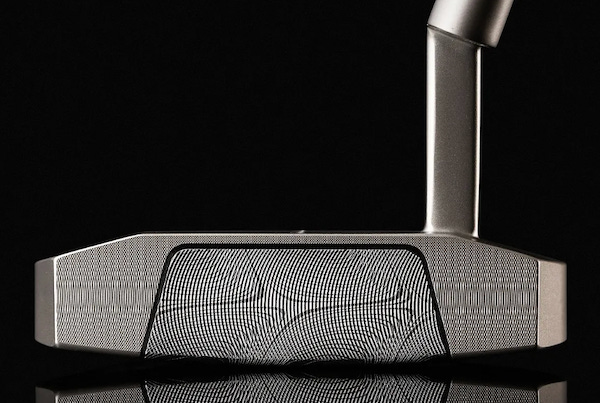
The Seven DB model uses a double-bend shaft with ¾ shaft offset and a face-balanced profile, making it suited to players with a straighter, minimal-arc putting stroke, while the Seven CH offers an alternative hosel configuration for different stroke types.
Odyssey has paired the head with a Rubber Tour Pistol grip developed with Golf Pride and an SL90 shaft featuring a 20g counterbalance weight, designed to improve tempo and stability through the stroke. The use of Damascus steel, rarely seen in putter inserts at scale, reflects a blend of traditional forging craftsmanship with modern performance engineering, positioning the model at the top end of Odyssey’s lineup for players prioritising precision milling, premium materials and consistent feel.