

GBR Weekly | Inside Golf’s $12.8 Billion Maintenance Economy: How Technology Is Reshaping Club Operations
Connecting the dots across golf’s business, media, and professional landscape.

Hello GBR community,
We always expect our golf courses to be in prime condition when we play. Whether that’s our home track or we are playing another course, we notice very quickly if the course isn’t in good condition.
I was a member of a course where the layout was visually stunning, offering expansive panoramas of Scotland’s beautiful East Lothian coastline; however, the course was always in terrible condition.
The course’s reputation was tarnished as a result; the club was always advertising for new members, visiting parties couldn’t be bothered to stop by, and very soon, the course closed. It didn’t last ten years.

While we’ve looked at how technology can be integrated into clubs to help enhance membership and guest experience, we haven’t delved too deeply into the requirements to present the course in near-perfect conditions all year round.
Greenkeeping has moved beyond mowing and maintenance; it’s become one of sport’s most tech-driven professions. We look at how U.S. clubs are adapting to new technologies, tightening budgets, and environmental pressures — and what it all means for the playing experience.
GOLFZON NAMED OFFICIAL INDOOR SIMULATOR PARTNER OF THE U.S. OPEN AND U.S. WOMEN’S OPEN
GOLFZON has announced a multi-year partnership with the United States Golf Association (USGA), becoming the Official Indoor Golf Simulator of both the U.S. Open and U.S. Women’s Open Presented by Ally. The collaboration will debut during the 2026 USGA championship season, starting with the U.S. Women’s Open at Riviera Country Club in Pacific Palisades, California. As part of the agreement, GOLFZON will provide interactive simulator experiences for fans and hospitality guests on-site.
The partnership also includes USGA support for the GOLFZON Tour, a competitive indoor golf series that connects teams nationwide via the company’s Network Play function, culminating in a $300,000 championship event. “We’re thrilled to partner with GOLFZON to bring our fans and hospitality guests a world-class indoor golf simulator experience that perfectly complements what fans have come to expect at our national championships,” said Jon Podany, USGA Chief Commercial Officer.
GOLFZON America CEO Sean Pyun added, “It’s a privilege to partner with the USGA to bring our immersive simulators on-site to the prestigious U.S. Open and U.S. Women’s Open.” More details of the partnership and what fans can expect at next year’s U.S. Open and U.S. Women’s Open Presented by Ally can be found here.
GOLF GENIUS LAUNCHES FOUR-STEP GUIDE TO HELP CLUBS MAKE SMARTER TECHNOLOGY DECISIONS
Golf Genius has released a new four-step framework to help golf club managers make more confident and data-driven technology decisions. Developed in collaboration with Players 1st, the Golf Club Managers Association, CMAE Scotland, CMAI, UK Golf Federation, and Golf Club Secretary, the guide offers a clear roadmap for assessing, selecting, and implementing software across club operations. Based on findings from the 2025 Golf Club Software Technology Report, which revealed that two-thirds of clubs are considering changing software providers and over half seek external guidance, the 32-page guide structures digital transformation into four key phases:
Investigation
Tender
Decision
Implementation
Each step is supported by practical tools, including a Software Audit Tool, Total Cost of Ownership Calculator, Request for Proposal Template, and Supplier Evaluation Matrix, helping managers evaluate systems, benchmark suppliers, and assess long-term value. “Software has become a strategic asset, not just an operational tool,” said Craig Higgs, Managing Director of Golf Genius International. “This framework was created to support club managers who want to make objective, informed decisions in an increasingly complex software landscape.” Jakob Buksted, Director of Research at Players 1st, added: “This project gives decision-makers the structure and insight they need to plan change responsibly and effectively.” The Golf Genius four-step framework can be accessed here.
NEWTON GOLF EXPANDS INTO JAPAN WITH LAUNCH OF DEDICATED E-COMMERCE PLATFORM
Newton Golf Company has announced the launch of NewtonGolf.jp. This new Japan-based e-commerce site allows golfers to purchase products directly, marking a major step in the company’s international expansion. The new platform provides localized access to Newton’s technology-based equipment, as the brand builds on its growing presence across the U.S. and Asia.
Dr. Greg Campbell, Newton Golf’s Executive Chairman and CEO, emphasized Japan’s importance to the company’s global strategy: “Japan is the world’s second-largest golf market and represents a major opportunity for Newton Golf. Launching NewtonGolf.jp allows us to meet that demand directly, providing golfers in Japan with the same advanced performance technology and customer experience that has driven our growth in North America.” The launch of the new website comes at a time when golf participation is rising across Japan. Newton Golf.
ST ANDREWS TO UNDERGO HISTORIC RESTORATION AHEAD OF 2027 OPEN CHAMPIONSHIP
The Old Course at St Andrews will undergo a significant enhancement and restoration project ahead of hosting the 155th Open Championship in 2027, the R&A announced this week. The work, led by renowned architects Mackenzie & Ebert, aims to refine strategic challenges for elite competition while restoring traditional features that have evolved over time, ensuring the world-famous links remain both a championship test and a cherished experience for everyday golfers.

“Our approach is grounded in deep respect for the course’s unparalleled history,” said Mark Darbon, R&A Chief Executive. “We believe this work is important in ensuring the Old Course continues to evolve and challenge the world’s best golfers while enhancing the experience of local and visiting golfers.”
Key updates include:
Lengthening six holes (5th, 6th, 7th, 10th, 11th, and 16th) and shortening the 12th, increasing total yardage by 132 yards to 7,445 yards.
Restoration of a historic playing route left of the “Principal’s Nose” and “Deacon Sime” bunkers on the 16th, with two new bunkers added to increase risk and strategy.
Relocation and reshaping of bunkers on the 2nd, 6th, 9th, and 10th holes, including restoring “Boase’s Bunker” to its traditional form.
Realignment of tees on the 12th and 14th holes for improved spectator flow and playability.
Restoration of the Road Hole Bunker on the 17th to counteract sand build-up.
This marks the most comprehensive update to the Old Course since preparations for the 144th Open in 2015, when adjustments were made to bunkers and green complexes. Work will begin on November 3. The Open.
Inside Golf’s Quietest Revolution: How Technology Is Redefining Greenkeeping
It’s easy to think of greenkeeping as the quiet art of mowing, raking, and rolling — the daily rhythm that keeps golf’s aesthetic intact. But that image is out of date. Today’s course superintendent operates more like a data analyst or environmental engineer than a groundsman. Smart irrigation grids, robotic fairway units, and predictive turf-health software have turned maintenance into a precise science — one that carries both enormous financial potential and existential risk for clubs that fail to modernise.
The High-Tech Backbone of Golf
Across North America’s nearly 16,000 golf courses, the machinery and systems that keep the game playable have become part of a multibillion-dollar ecosystem. According to the National Golf Foundation, there were nearly 16,000 golf courses at 14,000 facilities in the U.S. at the end of 2024. ngf.org
Meanwhile, the global market for golf-course operation services (which includes turf & grounds maintenance) in the U.S. was valued at approximately USD 6.01 billion in 2024, and is projected to reach about USD 9.03 billion by 2033, with turf & grounds maintenance dominating the growth. deepmarketinsights.com
On the equipment side, the global golf-course equipment market is forecast to grow from USD 4.47 billion in 2024 to USD 5.73 billion by 2029. thebusinessresearchcompany.com
Today’s top turf managers are embracing robotics, Internet-of-Things sensors, drones, and agronomic analytics. Autonomous fairway mowers from major OEMs can operate by GPS/geofence overnight; turf-stress drones map disease, compaction, or dry zones; soil-moisture sensors feed dashboards that alert superintendents before turf health fails. Water use can drop dramatically when clubs switch to smart irrigation.
But this isn’t a luxury, it’s increasingly a strategic imperative. Climate volatility, labor shortages, and rising input costs mean that turf is no longer just a backdrop; it is both an asset and a liability.
Why This Matters to Everyone — Not Just the Grounds Crew
For Club Management & Executives (GM, CFO, Marketing):
The condition of your course directly affects guest satisfaction, membership retention, and ancillary revenue streams (F&B, hospitality, lodging). Neglecting greenkeeping technology isn’t merely a cost-cutting measure—it can become a revenue leak. A club that falls behind may see higher maintenance bills, greater use of temporary fixes, reputational decline, and potential difficulty hosting events.
For Golfers:
Players may not think about sensors and analytics, but they care about the outcome: consistent fairways, true greens, predictable conditions. When a course’s maintenance is lagging, so is the playing experience. And in a world where reviews, social media, and guest expectations matter, poor turf equals weaker return visits, negative word-of-mouth, and reduced green-fee revenue.
For Investors / Real-Estate Operators:
A well-maintained course is an asset. It elevates property values, supports premium memberships and guest rates, and allows event hosting. Conversely, maintenance backlogs or visible degradation reduce valuations, raise cap-ex outlays, and make the asset less appealing. The high-tech maintenance ecosystem is now part of the investment thesis.
For the Industry / Region:
The maintenance sector is large and growing—and systemic risk looms for those who don’t adapt. When a marquee course suffers agronomic issues, the impact ripples: tournament relocations, tourism declines, and local economic fallout. The recent example from Maui (below) proves that no club is immune.
When the Grass Fights Back
The risks of inaction are real and highly visible. Take the Plantation Course at Kapalua Resort in Hawaii: The course was forced into a two-month closure due to irrigation restrictions and turf health issues. (Golf Digest) The course is scheduled to open to golfers on November 10th; however, it’s too late to save the annual playing of The Sentry tournament, which is now off the schedule next January, with the PGA Tour’s season-opener now being the Sony Open.

The root cause? Drought, water-resource constraints, and delayed maintenance. For Kapalua, the turf health issue quickly escalated into a business crisis: the course’s ability to host a marquee event, retain its global reputation, and deliver tourism value was in jeopardy. (Golf Course Industry)
For many clubs, that scenario sounds extreme—but it underscores a broader point: turf will not wait. Whether you’re a municipal facility, a daily-fee resort, or a private country club, failure to modernise creates exposure.
The Economics of Staying Ahead
Investing in modern greenkeeping technology is not cheap—but the cost of falling behind can be even greater.
Up-front costs & scale:
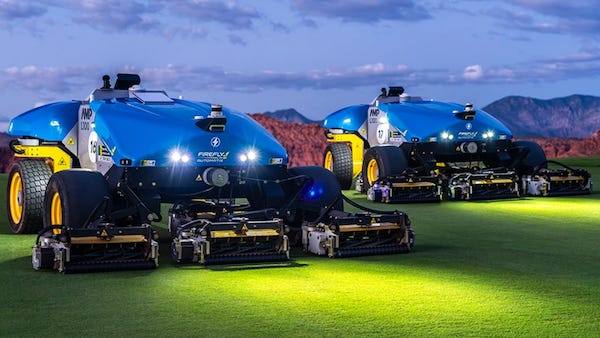
A single robotic greens mower can cost $35,000 to $70,000; equipping an 18-hole property with a full fleet plus GPS, infrastructure, and service licences can exceed $400,000.
An investment in soil-moisture sensors across all greens may add $25,000-$50,000.
Training staff to operate, maintain, and interpret advanced systems adds another dimension of cost and complexity.
Return on Investment (ROI):
Clubs that pilot automation report labour-hour reductions of 30-40 percent, freeing staff from routine mowing to focus on drainage, bunkering, agronomy, and guest experience. (One Colorado mountain course superintendent said automation “gave us back the craftsmanship — the time to make the course better rather than just keep up.”)
Water-use reductions of up to 30 percent have been reported when smart irrigation is deployed.
Over time, investment in automation helps reduce maintenance variability (which translates into more consistent play), fewer resource spikes (water, chemicals, fuel), and stronger sustainability credentials.
The flip side—costs of lagging
Clubs that delay technology adoption risk seeing maintenance bills rise disproportionately. Old irrigation systems may waste enormous volumes of water; manual mowing is less efficient (higher fuel, more staff hours). In drought-vulnerable states (e.g., California, Nevada), outdated practices can trigger regulatory penalties or forced closures.
Furthermore, a visible decline in turf condition affects member satisfaction, guest perceptions, and tournament eligibility—each of which hits revenue and brand value.
