

GBR Weekly | Acushnet’s Q3 Earnings 2025 — Key Numbers, Regional Trends, and Outlook
Connecting the dots across golf’s business, media, and professional landscape.

Good morning, GBR community,
The Open Championship seems like a distant memory now, but news this week released by the R&A confirmed what we expected to be the case in terms of how big a revenue generator the Open is becoming.
The biggest sporting event ever held in Northern Ireland provided an economic stimulus to the tune of £280 million.
The financial value is one thing, but it’s the long-lasting impact of tourism on the region, which will be felt for years to come.
In a busy news section, we report on the Indoor Golf Alliance’s announcement of its first conference to be staged next year in Las Vegas.
NGCOA CEO, Jay Karen, returns to Washington to provide testimony in the “Daylight and Destinations: Examining Time, Travel, and Tourism.” Subcommittee hearing.
Our big read focuses on the financial results published for Acushnet for Q3 2025. Is Titleist still providing the backbone of sales and profit, or has the FootJoy brand shown stronger sales during Q3? All is revealed in this week’s edition of GBR.
I know that many of you will be celebrating Thanksgiving next week, so I intend to get next week’s issue of GBR to your inbox before next Thursday.
Anyway, enjoy this week’s edition of GBR.
THE 153RD OPEN DELIVERS £280 MILLION ECONOMIC BOOST TO NORTHERN IRELAND
The 153rd Open at Royal Portrush generated more than £280 million ($366 million) in total economic benefit for Northern Ireland, according to independent research commissioned by The R&A and Tourism Northern Ireland.
An economic impact study by the Sports Industry Research Centre at Sheffield Hallam University found that staging the Championship delivered £89.2 million in direct economic impact, including £43.7 million ($57.1 million) within the Causeway Coast and Glens, while analysis by YouGov reported a further £191 million ($250 million) in global destination marketing value through television, digital, and online media exposure. The Open’s return to the Causeway Coast drew a record-breaking attendance of 278,000, making it the largest Open ever held outside St Andrews and the biggest sporting event in Northern Ireland’s history.

Ellvena Graham, Chair of Tourism Northern Ireland, stated that “golf tourism is a key driver for the local economy,” highlighting that 67% of attendees extended their stay, supporting communities across the region, while combined marketing efforts from Tourism NI and Tourism Ireland generated an additional £12.1 million ($15.8 million) in PR value. The full report of the economic impact of the 153rd Open Championship can be found here.
INDOOR GOLF ALLIANCE ANNOUNCES FIRST-EVER INTERNATIONAL TRADE SHOW AND CONFERENCE IN LAS VEGAS
The Indoor Golf Alliance (IGA) has announced the launch of the first International Indoor Golf and Technology Trade Show and Conference, set to take place July 7–9, 2026, at the Bellagio Resort and Casino in Las Vegas, Nevada. The event, held in partnership with SEICon, marks the inaugural global gathering dedicated exclusively to the indoor golf industry, bringing together leaders, innovators, entrepreneurs, and professionals to explore new business strategies, technologies, and growth opportunities.
Highlights of the event include:
Exhibits, live demonstrations, and educational sessions focused on facility operations, technology, coaching, and entertainment.
Networking experiences designed to strengthen industry connections and drive continued market expansion.
Educational tracks covering Business & Operations, Technology & Innovation, Player Development & Coaching, Entertainment & Community, and Industry Trends & Outlook.
“This marks a major step forward for the global indoor golf community, creating a platform where ideas, technology, and opportunity meet,” said Phil Immordino, President of the Indoor Golf Alliance. Further details and registration for the International Indoor Golf and Technology Trade Show and Conference can be obtained by contacting Phil Immordino directly at phili@indoorgolfalliance.org.
NGCOA CEO JAY KAREN TESTIFIES BEFORE HOUSE SUBCOMMITTEE ON TRAVEL, TOURISM, AND DAYLIGHT SAVING TIME
Jay Karen, CEO of the National Golf Course Owners Association (NGCOA), testified yesterday before the House Subcommittee on Commerce, Manufacturing, and Trade during a hearing titled “Daylight and Destinations: Examining Time, Travel, and Tourism.”
The session examined two major economic issues: how to sustain a strong U.S. travel and tourism industry, including preparations for global events such as the FIFA World Cup and the Olympics, and national policy on Daylight Saving Time, as lawmakers considered whether to adopt permanent Standard Time, permanent DST, or maintain the current system. Karen outlined how biannual clock changes influence golf course operations and wider recreation businesses, noting that “policies concerning time directly impact the hours available for leisure activities and, consequently, the economic vitality of our tourism sectors.”
The hearing, announced by Congressman Brett Guthrie and Congressman Gus Bilirakis, also included testimony from Rosanna Maietta of the American Hotel and Lodging Association, Dr. Tyler J. Kleppe of the University of Kentucky, and Lisa Simon of the International Inbound Travel Association. Further details of the Subcommittee hearing can be found in the full NGCOA press release.
CALLAWAY SELLS 60% OF TOPGOLF TO LEONARD GREEN IN DEAL VALUED AT $1.1 BILLION
Callaway is exiting majority ownership of Topgolf, agreeing to sell a 60% stake to private equity firm Leonard Green & Partners at an enterprise value of $1.1 billion, a 45% drop from the $2 billion valuation attached to Callaway’s acquisition five years ago.
Callaway will retain a 40% minority stake, while Topgolf Callaway Brands will be dissolved, with Callaway Golf Company re-emerging as a standalone equipment and apparel manufacturer listed on the New York Stock Exchange.
Leonard Green, which already held 4.9% of Topgolf Callaway and owns stakes in companies including Crunch Fitness and Authentic Brands Group, has now become the majority owner of a business that operated 100 venues at the end of last year (96 in the U.S. and four in the U.K.). The reduced valuation reflects Topgolf’s cooling momentum following the pandemic-era golf boom and the company’s decision last year to pursue a separation into two independent entities. “After a thorough evaluation of a range of alternatives, we believe this sale is the best outcome for our shareholders, as well as our employees and other stakeholders,” said CEO Chip Brewer, who will continue to lead Callaway once the deal closes in the first quarter of next year. More details of the sale can be found in the press release issued by Topgolf Callaway here.
Additional reading: Topgolf Callaway’s Q3 results and performance for the year to date can be found in last week’s GBR here.
FIVE IRON GOLF SECURES NEW FINANCING TO DRIVE UAE AND GLOBAL EXPANSION
Following on from last week’s announcement of a new flagship venue opening in the heart of London, Five Iron Golf’s UAE franchisee has completed a new financing round to accelerate its growth across the Emirates. The investment was led by Powerhouse Capital and joined by high-profile backers, including NFL legend Larry Fitzgerald, PGA Tour winner Kurt Kitayama, LPGA player Alison Lee, and Sharp Alpha Managing Partner Lloyd Danzig.
The franchisee, which opened its flagship Five Iron Dubai at the Westin Mina Seyahi in September 2024, has already signed leases for two new venues — a nearly 24,000-square-foot location at Yas Bay Waterfront on Yas Island, Abu Dhabi, featuring 12 Trackman simulators, chef-driven F&B, Callaway Tour fitting, and a waterfront terrace, and a third site at DAMAC Towers by Paramount, Business Bay, set to open in Q1 2026 with five simulators, a sports bar, and AR gaming.
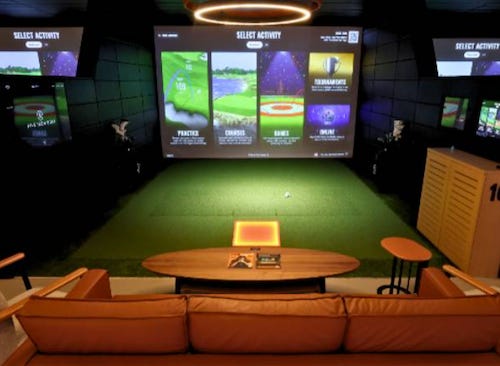
The group also plans to expand into Asia, Europe, and Africa, building on the success of its Dubai flagship. Golf Digest Middle East.
MOTOCADDY PARTNERS WITH GCAA AND WGCA TO ADVANCE ELECTRIC CADDY USE IN COLLEGIATE GOLF
Motocaddy has announced new partnerships with the Golf Coaches Association of America (GCAA) and the Women’s Golf Coaches Association (WGCA), aiming to expand the role of electric caddies across U.S. collegiate golf.
Under the agreements, Motocaddy will work with coaches, players, and governing bodies to share data on the health and performance benefits of electric caddies while gathering insights on how the technology fits into current and future college golf programs. “We recognize the influential voice collegiate coaches and players have in the U.S. golf ecosystem, and these partnerships will allow Motocaddy to further spread our vision for electric caddies to a wider audience,” said CEO John Helas.
As part of the initiative, Motocaddy will attend both associations’ national conferences in Las Vegas this December, support ongoing education efforts, and collaborate on marketing aimed at raising awareness and adoption among member programs. Further details on Motocaddy’s partnership with the GCAA and WGCA can be found here.
GOLFMANAGER RELEASES INDUSTRY’S FIRST GEO GUIDE AS AI TRANSFORMS HOW GOLF CLUBS ARE DISCOVERED ONLINE
Golf club software specialist, Golfmanager, has launched the golf industry’s first GEO (Generative Engine Optimization) guide, offering club managers a practical framework for adapting to a digital landscape increasingly shaped by AI-powered search.
The release follows findings from McKinsey’s 2025 report, which shows that 50% of consumers already use AI search tools and predicts that 20–50% of traditional search traffic could disappear as decisions shift directly into large language models.
McKinsey estimates that $750 billion in consumer spending will flow through AI search by 2028, with AI now drawing only 5–10% of its information from official websites and relying heavily on reviews, third-party content, and user-generated data.
Golfmanager’s guide warns clubs that golfers increasingly ask AI, not Google, where to play based on location, skill level, budget, and experience, making legacy web strategies insufficient. “The next era of search won’t be about clicks, but about conversations powered by Artificial Intelligence. Our commitment is clear: to prepare golf clubs for this new paradigm,” said David Sánchez, the company’s Chief Marketing & Communications Officer. The new GEO guide adds to Golfmanager’s recent resources, including the industry’s first ChatGPT white paper and first tailored prompting guide, underscoring its mission to help clubs safeguard visibility, reputation, and revenue as AI becomes the dominant channel for golfer discovery. Golfmanager’s GEO guide is free and can be downloaded here.
PGA TOUR WEIGHS MAJOR 2027 RESTRUCTURE
The PGA Tour is considering significant structural changes from 2027 onward, with proposals from the new Tiger Woods-led Future Competition Committee, including pushing the season’s start to after the Super Bowl, reducing the core schedule to around 20 events, and eliminating the current slate of $20 million signature events.
Speaking ahead of the RSM Classic, world No. 11 Harris English said the Tour is openly discussing “starting after the Super Bowl” because “we can’t really compete with football,” and suggested a streamlined, equal-status schedule would encourage top players to appear more consistently. The committee, formed by CEO Brian Rolapp to conduct a “holistic relook” at the regular season, postseason, and offseason, cannot make sweeping changes before 2027, as the 2026 schedule, featuring 33 consecutive weeks of play and eight signature events, has already been set.
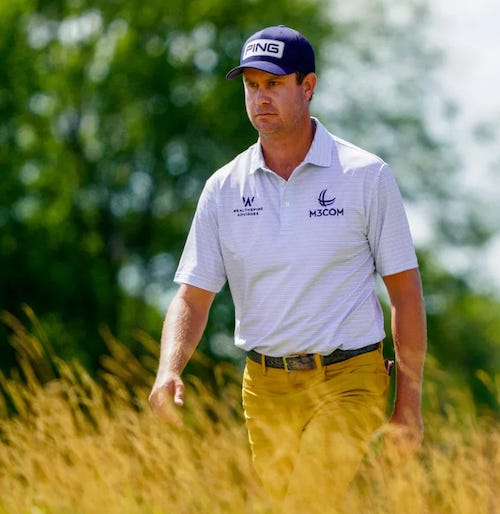
Before the cancellation of The Sentry, five tournaments were due to be held before Super Bowl LX, and any move to a post-Super Bowl start would place the AT&T Pebble Beach Pro-Am as the season opener. The shift would also contrast with LIV Golf, whose 2026 season begins Feb. 4–7, during Super Bowl week. English said a 20–22-event uniform schedule “is a good model,” removing disparities between elevated and regular events, while Rolapp has emphasised the importance of “scarcity” and “simplicity” in making the Tour easier for fans to follow. David Rumsey’s report for Front Office Sports can be found here.
DP WORLD TOUR’S BACK 9 AND PLAY-OFFS DRIVE SURGE IN GLOBAL VIEWERSHIP AND FAN ENGAGEMENT
The DP World Tour’s 2025 season closed with a sharp rise in global fan engagement, as the final 11 tournaments, spanning the Back 9 and the DP World Tour Play-Offs, delivered significant gains across broadcast audiences, on-site attendance, and digital interaction.
Average TV viewership increased 35% on Golf Channel in the U.S. and 16% on Sky Sports in the U.K., with standout spikes at the Amgen Irish Open, which set a Sky Sports record for peak viewership at a DP World Tour event, and the DP World India Championship, which posted the network’s highest-ever average audience for an Asian tournament outside the UAE.
The season-ending DP World Tour Championship in Dubai recorded a 39% jump in average viewership and a 92% rise in peak viewership compared with 2024, extending momentum from a record-breaking 2025 Ryder Cup. Spectator numbers also rose, with cumulative attendance for the 11 events up 2% year-on-year (and 7% versus 2023), drawing more than 500,000 fans. Digital reach accelerated further: video views on TikTok, YouTube, and Instagram climbed 34%, social impressions grew 47%, engagements rose 54%, and page views on the Tour’s website increased 10%, underscoring robust, multi-platform growth as the 2025 season concluded. DP World Tour.
LPGA SETS NEW RECORD WITH $132 MILLION SEASON PURSE FOR 2026
The LPGA will offer a record $132 million in prize money during its 2026 season, an increase of roughly $1 million year-on-year, with around $50 million allocated to the five majors, up $3 million collectively from 2025, and $82 million assigned to non-major events.
The tour confirmed that 12 tournaments will feature elevated purses next season and that more than 15 events will guarantee minimum payouts for all players. The 2026 schedule includes several changes: Fortinet becomes the title sponsor of the Fortinet Founders Cup (March 19–22) in Menlo Park, California, replacing last year’s unsponsored event in Bradenton, while the tour adds the Aramco Championship, a $4 million event staged at Shadow Creek in Las Vegas in partnership with Golf Saudi and the Ladies European Tour.
The debut Black Desert Championship drops off the schedule as its host resort shifts to a marketing-partner role. Meanwhile, the Chevron Championship, the year’s first major, is expected to move from The Club at Carlton Woods in Houston to Memorial Park, though the official venue remains listed as TBD on the newly released calendar. Josh Carpenter, Sports Business Journal.
ACUSHNET Q3 2025: A STEADY QUARTER BUILT ON TITLEIST STRENGTH AND RESILIENT US DEMAND
Acushnet’s third-quarter results illustrate a company navigating a mixed global landscape with notable discipline. Titleist continues to provide robust momentum — particularly in golf balls and the latest T-Series irons — while regional patterns and trends within FootJoy add nuance to what initially appears to be a straightforward set of numbers.
For the three months to 30 September, Acushnet reported net sales of $657.7 million, an increase of 6% over the same period last year. Growth was supported by strong demand in the United States and Europe, while Asia told a more complex story. Profitability improved as well: Adjusted Earnings Before Interest, Taxes, Depreciation, and Amortization (EBITDA) rose 10% to $118.6 million, a measure that reflects the company’s underlying operating performance before interest, taxes, and non-cash accounting expenses.
That rise in EBITDA is particularly informative this quarter. It shows that Acushnet’s core business — driven by the dependable pull of Titleist — is generating healthy operating cash flow even as certain regions and product categories face pressure. In a year that has been anything but uniform across global golf markets, this consistency is notable.
Titleist’s Performance Sets the Pace
Titleist remains the heartbeat of the business. Its golf ball line, anchored by the Pro V1 range, delivered another strong quarter, supported by the successful launch of the updated T-Series irons and the ongoing success of the GT-Series. Higher selling prices in clubs and sustained ball volumes helped lift Titleist equipment revenue by around 6% year-on-year, reinforcing its status as one of the most resilient franchises in the sport.

This strength is not new; Q1 and Q2 both demonstrated the same pattern. But Q3’s performance is further confirmation that Titleist is operating on a different rhythm to the broader equipment market, one driven by repeatable replacement cycles and long-term brand loyalty rather than seasonal fluctuations or fashion-led trends.
FootJoy: Stabilizing, but Footwear Continues to Lag
FootJoy’s performance, while improving, reflects a more cautious consumer backdrop. The brand recorded modest growth in the third quarter, helped by higher average selling prices in apparel and gloves. But the core footwear category — historically FootJoy’s backbone — continued to soften.
Footwear volumes once again declined in Q3, marking the third consecutive quarter of contraction. When looking across the year, FootJoy’s footwear revenues are still below 2024 levels, and both Japan and Korea remain areas of particular weakness. This is consistent with trends identified earlier in the year, underscoring the headline theme that Titleist’s strength is doing most of the heavy lifting while FootJoy works through a slower cycle.
A Geographical Breakdown Of Q3
Acushnet’s global footprint continues to shape its quarterly profile, and Q3 was no exception. The divergence between regions was pronounced, with the United States and Europe helping to lift the quarter while Japan remained under pressure and Korea delivered a modest but uneven improvement.
United States: Reliable Strength and Clear Momentum
The United States delivered the most substantial contribution to Q3 growth, with sales rising $20.8 million year-on-year. The increase was driven primarily by Titleist equipment, which alone accounted for $13.4 million of the uplift, supported by the strong launch of the updated T-Series irons and sustained demand for Pro V1. Golf Gear added a further $4.8 million, while FootJoy wear contributed $2.4 million, reflecting stable apparel sales even as footwear volumes softened globally.
This performance reinforces the U.S. as Acushnet’s anchor market. Domestic consumer demand remains notably resilient, and the company continues to benefit from both loyal golfers and a favourable product cycle in clubs and balls.
Europe: Broad-Based Gains Across Key Categories
EMEA markets also contributed positively, with revenue increasing $2.4 million compared with the same quarter last year. Growth was broad-based, spanning Titleist equipment, FootJoy apparel and gloves, and golf gear. Europe’s consistent performance throughout 2025 has been a quiet but important counterbalance to the more volatile conditions in parts of Asia.
South Korea: Mixed but Improving
Korea produced a modest increase of $1.1 million, led by higher sales of Titleist golf equipment, which grew by $1.3 million in the quarter. The improvement was held back by a $0.7 million decline in FootJoy wear, reflecting ongoing softness in premium footwear, a theme common across several markets. Even so, Korea finished the quarter in a stronger position than it started the year, with ball volumes showing particular resilience.
Japan: Another Difficult Quarter
Japan remained the clear weak spot in the regional mix, with Q3 sales declining $6.3 million, driven by lower revenue across all categories, Titleist equipment, FootJoy, and gear: consumer caution, currency-linked price sensitivity, and a softer year for footwear combined to depress volumes. Japan has been consistently challenging throughout 2025, and Q3 offered no sign of a near-term reversal.
