



HOUSEKEEPING BEFORE WE START: Golf Business Review is made possible by the support of its readers and by carefully selected partnerships that sustain our independent editorial work. If you would like to support independent, long-term coverage of the global golf industry — and access the full GBR archive — subscribe here.
HOW TO PARTNER WITH US: If you are interested in contributing to and strengthening our content offering as a partner, company, or institution, we would be pleased to hear from you at newsroom@golfbusinessreview.com.
MANAGE YOUR SUBSCRIPTION: If you no longer wish to receive our emails, you can unsubscribe here.
Hello GBR,
Who would have had Aaron Rai down as the winner of the PGA Championship? Congratulations are in order for a player who bucks many trends of tour players and finds his own way to get the job done.
Rai spent much of his childhood honing his game on the driving range, a reminder that ranges have always had the power to shape golfers. What is changing now is what those spaces can become. The 2026 Solheim Cup is not waiting until next September to reach golfers: Inrange Golf and the Dutch Golf Federation are taking Bernardus Golf into bays worldwide, using the tournament’s host venue as the centerpiece for a global activation built around competition, entertainment, and commercial value for off-course operators.
Our lead story from GOLF.AI. looks at how AI in golf is no longer just about better websites, booking systems, or chatbots. The next shift may be more practical: course teams building their own AI agents to answer questions, capture inquiries, reduce staff pressure, and turn everyday operational knowledge into faster service for members, visitors, and golfers.
Enjoy today’s GBR.
GOLF’S NEXT BIG SHIFT: COURSE TEAMS WILL BUILD THEIR OWN AI AGENTS
For twenty-five years, golf’s digital infrastructure was built by outside providers. Websites by web developers. Apps by software companies. Booking engines by tee-sheet vendors. A technology firm built it; a golf course bought it.
The AI era breaks that pattern. Building an agent is now prompt-driven, no-code, and accessible — you need workflow knowledge, context, and a clear problem to solve, not a software developer. That changes who builds, what gets built, and how fast the industry moves.
The best agents will be built by the people closest to the work.
Golf course operators already know where the pressure points sit. They know which questions members ask every day. They know where booking inquiries get stuck. They know which policies cause confusion. They know how much time repetitive calls consume. They know how many lesson inquiries go unanswered. They know email is losing effectiveness with members. They know how much operational knowledge lives in heads rather than systems.
That proximity is an advantage. A software provider understands the broad category; golf course staff understand the workflow — the difference between a Saturday competition call and a visitor inquiry, or why a lesson booking needs handling differently from a corporate golf day. The most powerful agents will be built from that knowledge: questions staff answer daily, policies members misunderstand, booking journeys that create friction, missed sales opportunities, and expertise that lives in experienced heads.
An AI agent is not a chatbot.
It is not a better FAQ page. It is a trained digital worker that understands a specific job, follows course-approved instructions, and helps create an outcome. It can answer, explain, recommend, book, update, guide, remind, capture, qualify, and support. No code, no complex software build, no six-month project — just knowledge, instructions, and outcomes.
The agent map is already forming.
A General Manager builds a pricing policy agent — green fees, member guest rates, visitor access, peak and twilight pricing. A Head Professional builds a coaching inquiry agent — lesson questions, packages, student goals, and bookings. A Pro Shop team builds a course information agent — tee times, dress code, cart availability, range access, weather policy, and competition schedules. A membership team builds a new member onboarding agent — club introduction, key contacts, common questions, and faster settling. An F&B team builds a restaurant booking agent for member dining, events, menus, and functions. An events team builds a corporate golf day agent — qualifying inquiries, packages, requirements, and sales follow-up. A committee builds a club policy agent — local rules, dress standards, guest policies, competition formats.
Examples are already emerging.
Golf courses are building AI Concierge agents via GOLF.AI’s platform — a dedicated AI phone number answered by Sir Nick Faldo’s digital twin, with a first agent live in under five minutes at courses.golf.ai. PGA Professionals are building lesson booking agents personalized to their coaching style, schedule, and student journey. Rules experts are building plain-language agents for complex situations, including course-specific local rules. Club captains are building member communication agents to reduce volunteer pressure as email effectiveness declines. Golf association employees are building competition agents that update players, explain formats, and give golfers conversational access to tournament information. Fans are building agents that track players, rounds, schedules, and performance trends.
The new operating layer.
The website gave golfers information. The app gave golfers access. The agent gives golfers action.
An agent does not display information — it helps something happen: answering a question, capturing an inquiry, triggering a booking, explaining a policy, supporting a transaction. It sits between golfers and courses, between members and operations, between staff knowledge and customer service, between inquiries and revenue, between friction and outcomes.
Why this matters for operators.
AI agents remove repetitive work from staff, freeing time for members, visitors, and revenue. They reduce pro shop phone pressure, improve after-hours response times, and capture inquiries that would otherwise be missed. They give younger staff instant access to course-approved knowledge and help experienced staff turn expertise into scalable systems.
For golfers, the shift is direct. They do not want to navigate pages, menus, PDFs, and booking engines. Increasingly, they will just ask about tee times, lessons, competitions, membership, rules, and events. AI agents allow courses to answer instantly, accurately, and in the voice of the club.
The golf industry has always been powered by people who love the game. What changes is what those people can now build — intelligent tools created by the people closest to the work, supporting their role, their team, their members, and their golfers. The courses that move first will answer more inquiries, capture more opportunities, and deliver a more intelligent golfer experience.
The future of golf will be built by the people who understand the game best. Many of them already work inside your golf course.
Start building your first AI agent at the GOLF.AI Concierge platform.
INRANGE BRINGS THE SOLHEIM CUP TO THE DRIVING RANGE — WITH BERNARDUS GOLF AS THE STAGE

The 2026 Solheim Cup host venue is coming to bays worldwide. In partnership with the Dutch Golf Federation, Inrange Golf will deliver a special Solheim Cup activation across its global network, allowing players at 85+ venues to virtually experience Bernardus Golf — the Kyle Phillips-designed championship course in Cromvoirt, Netherlands, that has hosted three editions of the KLM Dutch Open on the DP World Tour.
The activation is integrated into Season 3 of the Inrange World Tour, which saw over 30 million visitors to partner venues across 16 countries in 2025. Starting in June, players will declare allegiance to Team Europe or the U.S. Team. The format spans three rounds of competition, combining individual precision challenges, social scramble formats, and a Par 3 challenge on the virtual Bernardus Golf course.
“The transition of Range Golf from isolated practice to structured, competitive golf and entertainment is accelerating,” Inrange Golf said. “High-profile global campaigns of this calibre deliver tangible commercial value for operators while redefining how players engage with off-course golf worldwide.”
The 2026 Solheim Cup takes place September 11–13 at Bernardus Golf, Cromvoirt, Netherlands. It will be the 20th edition of the biennial match-play contest between the best players from the LPGA Tour and the Ladies European Tour.
For operators running Inrange-powered venues, the activation runs automatically — no additional programming or staffing required.
For more information on Inrange Golf, visit their website.
You can also follow them on LinkedIn for the latest news and product innovations from their team.
👉 You can read the full press release on Golf Business Review here.
POWER TEE EXPANDS TRAFFORD GOLF CENTRE INSTALLATION AS REFURBISHED VENUE REOPENS
Power Tee has announced a major expansion with Trafford Golf Centre, Manchester, England, following the reopening of the venue after a major refurbishment.
With 46 new automated teeing systems already installed and a further 31 units scheduled for October 2026, the site will have 77 Power Tee bays in total. The first phase of the redevelopment was unveiled when the center reopened on Saturday, 18 April, with the upgraded range now offering 50 redesigned heated bays, Power Tee auto-tee technology, upgraded seating, premium golf balls, a redesigned outfield with eight target greens, more left-handed and dual bays, improved lighting and sound, longer opening hours, and new hospitality features.
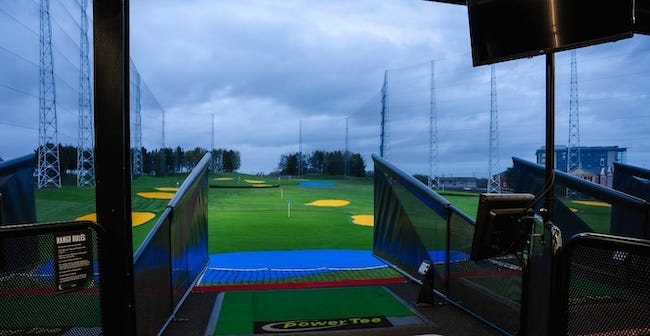
“Power Tee helps facilities improve customer comfort, increase repeat visits and modernise the range experience,” said Power Tee UK managing director Tony Eccleston, while Trafford Golf Centre director of golf Pete Styles said the next phase was about improving the experience for regular users after strong demand in recent years. The reopening also forms part of continued investment in The Academy, described as the UK’s largest golf coaching facility, alongside a new website and planned additions later this year, including premium lounge bays and EV charging stations at the site next to the Trafford Centre, which also includes Dino Falls Adventure Golf and American Golf’s flagship retail store.
SKYGOLF AND THE GOLF LAB FORM PARTNERSHIP AROUND CONNECTED COACHING AND FITTING DATA
SkyGolf has announced a strategic collaboration with The Golf Lab and performance specialist Liam Mucklow, aimed at expanding the use of connected golf intelligence across coaching, fitting, and player development.
The partnership brings together SkyGolf’s growing SuperTag ecosystem with The Golf Lab’s work in biomechanics, coaching science, advanced fitting, and technology-led player improvement, and will initially cover SDK integration, technology collaboration, SuperTag licensing and reseller initiatives, strategic advisory work, coaching and fitting workflow development, product development cooperation, and the exploration of future education and certification programs.
SkyGolf said the relationship could later broaden into areas such as connected fitting intelligence, AI-assisted coaching systems, player-equipment interaction modeling, and future OEM initiatives. Unlike traditional shot-tracking products, SuperTags are designed to capture swing and club-performance data automatically on every shot or putt across the course, practice ground, studio, and simulator, linking performance outcomes with underlying movement and club-delivery data.
“The future belongs to connected intelligence platforms capable of linking performance, coaching, fitting, equipment, simulation, and long-term player development together in meaningful ways,” said SkyGolf chief executive Richard Edmonson, while Mucklow said the long-term opportunity lay in helping coaches, fitters, OEMs, and golfers better understand how equipment, movement, and performance interact over time.
AZALEA AND BUFFALO GROUPE FORM GLOBAL GOLF AND LIFESTYLE MARKETING ALLIANCE
Azalea and Buffalo Groupe have announced a strategic partnership designed to give golf, tourism, hospitality, real estate, product, and apparel brands a single international agency solution across Europe, North America, and beyond.
The alliance links Azalea’s European PR and marketing network with Buffalo Groupe’s U.S.-based marketing, research, events, and media platform in response to growing demand for coordinated campaigns that work across the UK, continental Europe, the United States, and Asia. The agencies said the partnership is aimed at brands seeking consistent global storytelling as international golf travel grows, with stronger inbound U.S. traffic to destinations in Spain and Portugal alongside continued demand for Great Britain and Ireland and rising Asian interest in premium golf experiences.
Azalea, founded in 2006 and based in Hampshire, works across PR, media relations, content, influencer activity, events and social strategy for clients including Costa Navarino, Apes Hill Barbados, Troon International, Tourism Ireland, Quinta do Lago and OGIO, while Charleston-based Buffalo Groupe, formed after Buffalo Agency spun out of Billy Casper Golf in 2019, serves sectors including golf, travel, hospitality and real estate for clients such as Casa de Campo, Cleveland/Srixon, ECCO, Omni Hotels & Resorts, Play Golf Myrtle Beach and Youth on Course.
“Together we are one truly global solution,” said Azalea founder Andy Barwell, while Buffalo Groupe president Emily Clark said the partnership would create “a powerful, one-stop solution” for brands targeting the global golf lifestyle audience, with day-to-day delivery handled by aligned UK and U.S. account teams using shared planning, common metrics, and regular cross-agency collaboration.
TOPGOLF RECASTS LEADERSHIP TEAM AS IT PUSHES NEXT PHASE OF OPERATIONAL AND TECHNOLOGY GROWTH
Topgolf has announced a broad set of leadership appointments and promotions as it looks to strengthen operational performance and support long-term growth across the business, drawing executives from entertainment, hospitality, gaming, and technology.
New arrivals include Jay Spears, who joined on April 6 as chief information officer to lead the global technology organization across areas including cybersecurity, data and games, and Jason Weatherford, who also joined on April 6 as vice president of in-venue services in a newly created role overseeing food and beverage, retail, procurement, security, safety, facilities, and golf instruction.
Topgolf has also expanded the responsibilities of several existing executives, with Erin Chamberlin becoming president and chief operating officer, Susana Arevalo promoted to chief financial officer, Jon Olsen to general counsel, Scott Blevins named president and general manager of Toptracer with added oversight of Topgolf Swing Suites, and Amanda Lily Lam appointed vice president of golf marketing for Topgolf and Toptracer to lead golf partnerships.
The company has also shifted from a two-region to a three-region operating model, with Cheli Breaux and Chris O’Neil elevated to regional vice presidents and Northscott Grounsell joining on May 11 as the third regional vice president. Chief executive David McKillips said the company was building a leadership team with the expertise to guide Topgolf through its “next chapter”.
TRUE SPEC GOLF OPENS SECOND ORLANDO FITTING SITE WITH TRACKMAN-BASED BAY
True Spec Golf has opened bookings for True Spec Orlando West, with the new facility set to open to the public on June 1, giving the company a second Orlando location alongside its Grande Vista site, which opened in 2022.
Based at Athletic Motion Golf Club in Winter Garden, the new site features an indoor fitting bay equipped with Trackman launch monitor technology and access to True Spec’s brand-agnostic fitting matrix of more than 70,000 clubhead and shaft combinations from all major equipment brands. Clubs fitted at the site will be built at True Spec’s Scottsdale headquarters to the exact specifications identified during the fitting process. Athletic Motion Golf Club, which has eight bays powered by Trackman, is positioned as a high-end indoor golf venue in Central Florida, with True Spec Golf president Scott Anderson noting, “With their advanced technology and smart setup, Athletic Motion Golf Club is an ideal partner for us in the area.”
AMGC owner Shaun Webb said the partnership would allow the venue to offer “Tour-level club fittings” on site.
GOLF LEAGUES BECOME A BIGGER PART OF HOW AMERICANS PLAY
Golf leagues are becoming a more important part of the U.S. golf economy, with the number of golfers taking part in leagues rising 68% since 2019, compared with a 20% increase in on-course golfers over the same period, from 24.3 million to 29.1 million.
The stats come from a new report from the National Golf Foundation, which pinpoints that the growth reflects demand for golf’s social and competitive qualities, while also giving players more dependable access to the game at a time when nearly two-thirds of public facilities say they are at or near capacity.
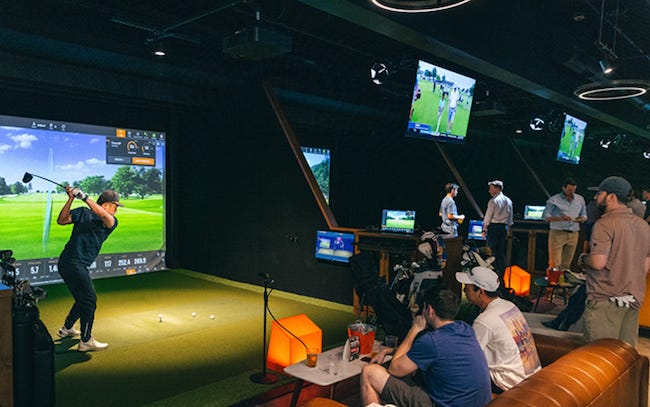
Leagues, often built around evening nine-hole blocks, are helping turn golf into more regular “appointment golf”, making it easier for players to fit rounds into busy schedules. The data also suggests league golfers are disproportionately valuable: they play more than twice as many annual rounds as non-participants, spend more, and are more likely to keep playing. League participation has also become more diverse, with higher representation from women, younger golfers, and People of Color, while occasional golfers playing fewer than eight rounds a year are also joining in greater numbers.
For operators, the trend points to leagues becoming more than a programming extra, instead serving as a tool to manage demand, deepen customer habits, and build longer-term retention in a capacity-constrained market.
LIV GOLF PREPARES TO SEEK UP TO $250M FROM NEW INVESTORS AFTER PIF EXIT
LIV Golf is preparing to raise up to $250 million from new investors after losing the backing of Saudi Arabia’s Public Investment Fund, according to Axios, with the league planning to present the fundraising strategy to players, including Jon Rahm and Bryson DeChambeau, before going to market.
The process will be managed by Ducera Partners, with the plan reviewed by LIV’s two new board members and restructuring firm Alix Partners. Prospective investors are expected to be told that a full $250 million raise could take the league to profitability in roughly 20 months, although LIV could also raise closer to $150 million and then rely on rising team valuations and a new media-rights deal.
LIV Golf is still operating with remaining Saudi capital, but is said to need new investment in place by the start of October, or it may have to pursue bridge financing. The current ownership structure leaves PIF controlling almost all of LIV itself and about 75% of each team, and the league’s pitch to investors is expected to argue that while Saudi funding reportedly totaled $5 billion, that same involvement deterred some sponsors, golfers, and audiences, meaning LIV’s next phase will depend on whether it can prove the business works on its own.
TAYLORMADE TO PAUSE ANNUAL DRIVER LAUNCHES WITH TWO-YEAR WOODS CYCLE
TaylorMade will not introduce a new driver in 2027, marking a significant change in product strategy for a company long associated with frequent driver launches.
The move to a two-year launch cadence for its woods lineup means TaylorMade is likely to go a year without a new driver for the first time since 2001, bringing it into line with the approach used by Titleist and Ping, while Callaway and Cobra remain among those still releasing new wood lines annually. The longer cycle will apply to the Qi4D family and reflects a broader pattern already in place across TaylorMade’s irons, wedges, and golf balls.
Brian Bazzel, the company’s vice president of product creation, said the annual driver cycle belonged to a different era, when performance gains were easier to achieve, and innovation moved at a faster pace. He added that golfers’ expectations for year-on-year distance gains have become harder to meet as the category becomes more technically demanding.

TaylorMade also believes the modern buying cycle supports a slower release pattern. With fitting now central to driver purchases and prices in some cases 40% higher than five years ago, Bazzel said asking golfers to replace the most expensive club in the bag too often no longer makes sense.
Golf Datatech research shows the average driver replacement cycle among avid golfers is now close to five years, compared with 3.4 years in 2012. Bazzel also said fitters need more time to understand the nuances of a new woods family and communicate them effectively, while TaylorMade’s research and development team needs longer to produce meaningful gains, noting that innovation timelines are now closer to two-and-a-half years per model. The change comes as signs emerge of softer demand in the woods market: Golf Datatech said wood sales in March 2026 were down 15% in units year on year and down 12% for the year, with March unit sales, excluding the pandemic-hit 2020, at their lowest level for that month since 2002.