

Mastering Influencer Marketing in Golf
A Comprehensive Guide for Golf Professionals: Harnessing Social Media Influencers to Grow Your Golf Business, No Matter the Size or Stage

Hello, GBR family!
This week, we've been diving deep into influencer marketing. It's time to ask ourselves: Can we continue to ignore its potential, or should we embrace this powerful strategy?
Is influencer marketing living up to the hype? How can we separate fact from fiction and uncover its true value for our industry?
In this comprehensive guide, we'll cut through the noise and get to the heart of influencer marketing in golf. We'll explore its relevance, effectiveness, and practical applications for businesses like yours.
Note: This premium content is exclusively available to our valued paying subscribers.
Reading this guide will take approximately 23 minutes.
If you spot any errors, we apologize and appreciate your reporting them to newsroom@golfbusinessreview.com.
By reading this guide to the end, you will gain insights into the following topics:
The scope of the influencer marketing world.
How these new marketing techniques apply to the golf industry.
Who the major influencers are and an estimate of how much it costs to hire them.
Is that for you? Is this only for Callaway, Taylormade, and other executives from major corporations, or it could also be of interest if you’re the greenkeeper of a small club in Iowa?
A list of 10 essential tips to get started in this world, including how to detect local micro or even nano-influencers, how to turn your customers into influencers of your brand, and…
four very useful tools to start working with.
Let´s go!
The pandemic has led us to explore new pastimes, and golf has emerged as a favorite. This newfound interest has given rise to a wave of online golf influencers who are redefining the game’s appeal for the younger generation. Social media platforms like YouTube, Instagram, and TikTok are teeming with trendy, youthful, and diverse golf content.
Influencer marketing, once a peripheral approach, has now become a primary tactic for promoting a wide range of products, services, and lifestyles to eager audiences. It’s being utilized by industries spanning from retail and food service to travel and entertainment, aiming to create more genuine, experience-driven, and user-endorsed marketing moments.
Rather than merely promoting products and services, top influencers market their personal brand, experiences, lifestyle, and expertise. This approach makes everything they endorse appear as a must-have or must-do to their followers, adding a layer of authenticity and desirability.
This is why brands are keen to sponsor influencers. These popular and trusted personalities enhance the credibility of products and services just by associating with them.
Influencers are stepping up their game, becoming more professional. A significant number of influencers now have agents and managers on their team to help them broker deals and manage their personal brand. Regulations around influencer marketing are tightening up. Some countries, like the United Kingdom, have rolled out rules mandating influencers to disclose when they’re getting paid to endorse a product or service.

But is this really for me?
Definitely yes. No matter if you’re a high-ranking executive in a multinational golf corporation or a newbie intern at a small-town country club, the influence of this trend is undeniable.
Regardless of your level of engagement with social media, understanding the workings of influencer marketing is crucial in today’s world. It could be the deciding factor that sets your business apart from the competition.
✔️ The scale of the phenomenon: Numbers to consider
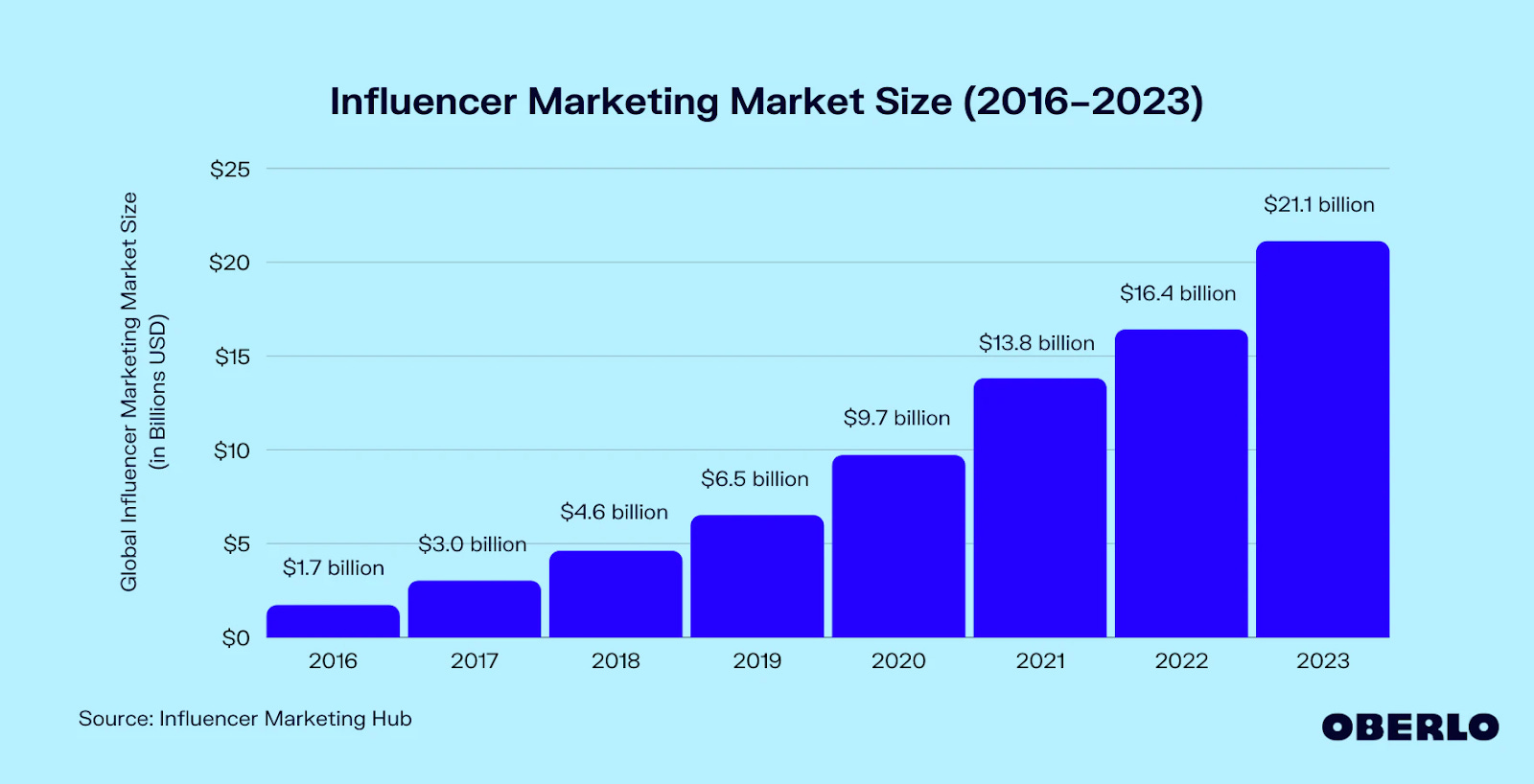
Global Influencer Marketing Landscape
According to the report Influencer marketing market size worldwide from 2016 to 2023, the global influencer marketing industry reached a staggering $21.1 billion in 2023, marking a threefold increase since 2019. With a projected CAGR of 25.9% from 2023 to 2028, the market is poised for further expansion.
In 2023, the influencer marketing market was valued at $8.2 billion for beauty, $5.6 billion for fashion, and $2.9 billion for travel. By 2028, these are projected to reach $11.6 billion, $8.3 billion, and $4.4 billion respectively.
Regional Spotlight:
The United States leads the pack with a market value of $12.9 billion, with Europe and Asia following closely behind at $4.5 billion and $2.7 billion, respectively.
Platform Preferences:
Instagram, YouTube, and Facebook reign supreme in the U.S. and Europe, while TikTok, WeChat, and Weibo dominate the Asian market.
Influencer Impact
The 2023 Global Influencer Marketing Report by Mediakix revealed that 55% of consumers’ buying decisions are influenced by social media influencers’ posts.
On average, consumers spend $69.48 per year on products or services they discovered through influencer marketing.
Instagram is the top platform for influencer marketing with 70%, followed by YouTube at 51%, and TikTok at 50%.
The most favored types of influencer marketing include product endorsements (31%), lifestyle content (24%), and live streams (19%).
66% of consumers trust influencer recommendations more than traditional ads.
72% of consumers follow at least one influencer on social media.
The Evolution of Influencer Platforms: A Snapshot
As the industry evolves, the platforms used for influencer marketing are also expanding, leading to more fruitful partnerships between brands and creators.
TikTok: The New Kid on the Block
TikTok has quickly become a preferred platform for influencer marketing, thanks to its massive download numbers, extensive reach, and high engagement rates, especially among Gen Z users, one of the greatest challenges for our industry. Micro-influencers are also making waves on the platform, often achieving even higher engagement rates. As TikTok’s influence continues to grow, it’s definitely a platform to watch.
Instagram: The Influencers’ Haven
Instagram continues to thrive as a go-to place for influencers, despite the rise of TikTok.Post-pandemic, Instagram’s brand value has been on the upswing. Instagram is not just a place to discover influencers; it’s also a platform where companies can directly connect with potential partners.
Instagram provides a variety of formats for creators to showcase a brand’s offerings, from photos and tags to Stories and Reels.
In 2023, brands were posting an average of five sponsored posts per week on Instagram, contributing to a global market worth $17 billion.
YouTube: The Tried-and-True Platform
YouTube has become the go-to platform for millions of viewers, who are tuning in to watch games played by golfers who are often just average players.
The time spent watching on-demand golf content on YouTube now surpasses all other forms of passive golf entertainment, including watching professional games on television.
But there’s more to this trend than just the time spent. YouTube golf has sparked a cultural shift. Videos are filled with hundreds of comments, and channels with millions of subscribers have bustling Reddit pages. Entire communities are forming around golfers who have developed unique personas, much like characters in a sitcom.
According to the data, younger golf fans, specifically those aged 18-32, are gravitating towards the YouTube version of golf. This contrasts with the average age of a PGA Tour viewer, which is over 60.
Just how big is it? Take the PGA Tour for instance. Despite facing competition from LIV, it continues to be the platform for the world’s top golfers and boasts 1.3 million subscribers on YouTube. On average, the Tour’s videos garner about 85,000 views, with around 34 “engagements” per video, encompassing comments and other interactions.
This organization holds the video rights and has access to an extensive library of past and present footage, effectively bringing the world’s top golfers into everyone’s homes. It’s the leading tour of professional golfers on the world’s most frequented video site. The channel was launched 15 years ago, around the time when YouTube was just beginning to gain popularity.
However, when compared to other golf channels on YouTube, the PGA Tour seems to take a backseat. Consider GoodGood, for instance, which describes itself as “six dudes, one golf channel.” They have 1.4 million subscribers, just a tad more than the Tour, but their videos are viewed an average of 545,000 times. There are 717 engagements per video. And the channel is only three years old.
✔️ Decoding the diverse influencer landscape of golf: From Tiger-Mania to the Influence Uprising
Golf influencers have traditionally been tour players and pros, setting the standard for amateurs and weekend warriors in terms of gear, style, and play.
Tiger Woods was a game-changer, making golf cool, athletic, contemporary, and bold like never before. He inspired a new generation of golfers and single-handedly reshaped the game’s culture in the 2000s.
Before online influencer marketing took off, big brands like Nike, Buick, Bridgestone, TaylorMade, and the PGA Tour leveraged Tiger’s influence to elevate their brands, generate buzz, and boost sales.
The New Wave
Post the ‘Tiger Boom’, a fresh wave of golf influencers is leveraging social media to:
Establish their personal brands
Create engaging golf content
Cultivate a vibrant culture around the game
Draw interest from younger generations and new demographics
Monetize their influence
This diverse group includes everyone from former pros and college players to current pros, equipment fitters, everyday golfers, and innovative direct-to-consumer brands. They’re all contributing to the evolving aesthetics and vibe of the game.
But, is gold all that glitters?
Ed Sanchez, the head of Golf Pulp, a marketing firm based in San Diego believes that golf influencers can be categorized into four distinct groups: Instructors, Golfers, Models, and Tricksters.
Instructors are often seen as the most genuine influencers for introducing products, regardless of their credentials. They are deeply involved in improving the game and are ideally positioned to test and review golf products. Instagram has been a revolutionary platform for golf instructors, especially those who struggled to effectively manage their own websites. It provides them with a stage to demonstrate their skills, build an audience around their techniques, and act as product ambassadors for golf brands.
Golfers are excellent influencers because their audience is usually built on their success. These are the individuals that people follow. They could be an up-and-coming pro with a talent for social interaction or a professional golfer who has earned a reputation through their performance on the course. However, top-tier professionals can be difficult to access and might require a significant investment for a brief moment of brand exposure.
Models attract a lot of attention from golfers, but does that equate to influence? There’s a frenzied fascination and objectification of golfers who have a decent swing and wear revealing attire. It’s as if people are surprised that someone attractive can swing a golf club. But is there more to it? This type of influencer is common and can pose a challenge for brands, especially considering the current social issues that are now intertwined with a brand’s identity.
Tricksters have found a home on social media for golf entertainment. Beyond the formal commentary of traditional media, a community of trick-shot golfers has emerged, amassing a large following with their impressive stunts. While these golfers are certainly entertaining to watch, brands with a serious image might find it difficult to do business with these influencers due to the nature of their content. A serious product needs to be perceived as such. It’s hard to gain the same level of credibility from a trickster that you would from a renowned golf instructor.
✔️ But at what cost? Can Your Business Afford It?
Where should we kick things off? What might be the cost for me to reach these new audiences through these novel communication channels?
When seeking influencers to collaborate with, it’s crucial to find someone who aligns well with the campaign you’re planning. For example, if your campaign revolves around food and beverages, a local food or lifestyle blogger with a local following could be an ideal choice. Don’t shy away from asking them to share their audience demographics. This can help you determine if their audience matches the target demographic of your campaign, which could be a specific gender or age group.
The cost of influencer marketing can vary depending on the influencer. Some might offer promotional services in return for gifted items or experiences, while others may charge a fee. Some might even do both.
A general guideline could be to allocate around $100 for every 10,000 followers.
So, let's start by aiming high…
✔️ The Golf Influencers Powering the Course: Meet the Top Influencers in the World
Paige Spiranac, a sports humorist with a massive Instagram following of 4M and a YouTube following of 433K, shares content about golf, fitness, and her personal life. She also operates a subscription site on Passes. Spiranac is a former Division 1 golfer at both Arizona State University and San Diego State University, and a former professional golfer.
Her content, which includes on-course vlogs, lifestyle posts, and instructional videos, has made her a key figure in the new media landscape of golf. In addition to her social media activities, she serves as a brand ambassador for PointsBetUSA and has previously represented PXG golf clubs.
Rick Shiels, a YouTube sensation in the golf world, has amassed a substantial following of 2.89 million subscribers. His content spans a wide range of golf-related topics, including equipment reviews, instructional tips, and engaging golf stories. Shiels, a former golf teaching professional from Manchester, UK, launched his YouTube channel in 2011, initially focusing on golf instructional videos. Since then, his golf media enterprise has grown significantly, making him one of the most popular and influential figures in the global golf community.
Despite his strategic approach and firm independence, which allows him to maintain impartiality in his highly popular equipment reviews and other YouTube content, Shiels has leveraged his influence to secure brand ambassador deals with Lyle and Scott and Toptracer. He also frequently collaborates with The R&A to produce content related to the Open Championship. His “Break 75” content series alone has garnered tens of millions of views, enabling Shiels to create content at some of the world’s most renowned golf courses.
His channel has hosted some of the biggest names in golf, including Tommy Fleetwood, Adam Scott, Sir Nick Faldo, Lee Westwood, Bryson Dechambeau, and Rickey Fowler, further enhancing its appeal and reach.
Grace Charis boasts a substantial social media following with more than 3.5M followers on Instagram and close to 3M on TikTok. Her content primarily consists of entertaining golf videos and helpful tips for those keen on expanding their golf knowledge.
Bri Teresi, a model who transitioned into a golf influencer, has garnered a significant social media presence with 1.4M followers on Instagram, 325k on TikTok, and 1 million on Twitter. Her content is a blend of athleticism and allure, featuring stylish outfits paired with golf.
Good Good is a collective that produces content on YouTube, boasting 1.69M subscribers. Their content is characterized by its fun, relaxed nature, featuring on-course videos, team challenges, and more. They also operate a golf apparel company.
The group is composed of five golfers: Garrett Clark (founder of GM Golf, another YouTube channel), Matt Scharff, Stephen Castañeda, Luke Kwon, and Thomas “Bubbie” Broders. Their dynamic personalities and varying skill levels contribute to the engaging content they produce, which includes on-course scramble challenges and creative team format videos filmed at various courses across the USA.
Their laid-back, enthusiastic, and highly entertaining videos present golf from a modern perspective, targeting Gen Z and Millennial audiences. The crew dons Good Good apparel in every video, promoting new seasonal releases and various patterns available on their website.
In January 2023, Good Good announced a partnership with Callaway, which led to the crew using Callaway clubs and plans to eventually release clubs with Good Good branding. As part of this collaboration, Good Good has produced videos featuring Callaway ambassadors like Masters champion Jon Rahm, Sam Burns and Annika Sorenstam.
Tisha Alyn, a professional golfer who transitioned into a social media influencer, has a significant following across various platforms, totaling over 1.8 million. She provides a glimpse into her journey and the realities of being a golf media personality. This 27-year-old golfer from Southern California, sponsored by Puma Golf, is a popular figure on Instagram and TikTok. She has collaborated with a variety of brands, including Cobra, AT&T, Fab Fit Fun, BMW, Subway, Degree, Mastercard, and Best Western.
Garrett Clark, who goes by the moniker GM Golf, is a multifaceted personality (a golfer, YouTuber, entrepreneur, and social media influencer). He has amassed an impressive following, with an estimated 1.23M subscribers on YouTube and over 977k followers on Instagram. His content is diverse and engaging, featuring trick shots, challenges, and footage from his matches and practice sessions.
Clark’s gained popularity through his unique golf content on YouTube, particularly his golf challenges and trick shots. His engagement rates are noteworthy, with a staggering 42.37% on YouTube. He has also established connections with other influencers like Samuel Grubbs and Robert Terkla.
Zire Golf: With a massive following of 2.2 million on Instagram, they specialize in social media commentary and crowd-sourced videos.
Claire Hogle: With 941K Instagram followers and 155K YouTube subscribers, she shares instructional content, vlogs, and social media posts.
Me and My Golf: This YouTube channel, boasting 986K subscribers, is dedicated to golf instruction.
While the previously mentioned influencers are at the forefront, there’s a plethora of other creators, brands, and personalities making waves in the golf scene. Here are a few more worth exploring:
No Laying Up, with an X [Twitter] following of 470K and 164K YouTube subscribers, is top ranked on Chartable’s list of U.S. Sports Podcasts. This group of self-proclaimed “fanalysts” produces a variety of content, including podcasts, written journalism, digital videos, and social media posts, all catered to dedicated golf fans. Their comprehensive coverage of PGA Tour players, diverse golf podcasts, and engaging content have earned them a passionate audience and a reputation as one of the most respected modern media entities in golf in the USA. In 2023, they announced a partnership with Titleist, encompassing both equipment and content creation.
Fore Play Golf, a sports-focused YouTube channel, has a community of 480K subscribers. They offer a down-to-earth perspective on golf, discussing the game as if they were friends at a bar watching a match, expressing frustrations about the game’s challenges, and commenting on professional golf gossip.
Bryan Bros (George and Wesley Bryan): They have 431K subscribers on YouTube and are known for their golf trick shot videos and general golf-related content. Their audience is primarily male and based in the US, UK, and Canada. They gained popularity through their entertaining trick shot videos on social media.
Anthony Taranto: He is a fine artist known for creating custom designs on golf clubs. He has an Instagram account with over 134K followers. His audience typically consists of high earners aged 25-29, with brand affinities including Ferrari, Jack Daniels, Smith & Weston, and Ping Golf.
Tania Tare: With over 350K followers on Instagram, Tania is a golf trick shot artist and pro golfer. She is known for her golf trick shots.
Isabelle Shee: With an Instagram community of 371k followers, she is known as the Creative Director of IS Golf, a golf socks brand. She posts swing videos and modeling shots.
Kenzie O’Connell: She is a golfer from Nebraska known for her golf content on Instagram, where she has 135k followers.
Kyle Berkshire: Recognized for his long drives and course vlogs, he has attracted 700K followers on Instagram.
Peter Finch: His YouTube channel, with 670K subscribers, features on-course vlogs, equipment reviews, and instructional content.
Random Golf Club: Known for their apparel, accessories, on-course vlogs, and storytelling, they have 297K subscribers on YouTube.
Bob Does Sports: He has 870K YouTube subscribers, 735 Instagram followers and shares on-course vlogs and podcasts.
So, how do we get started?