


HOUSEKEEPING BEFORE WE START: Golf Business Review is made possible by the support of its readers and by carefully selected partnerships that sustain our independent editorial work. If you would like to support independent, long-term coverage of the global golf industry — and access the full GBR archive — subscribe here.
HOW TO PARTNER WITH US: If you are interested in contributing to and strengthening our content offering as a partner, company, or institution, we would be pleased to hear from you at newsroom@golfbusinessreview.com.
Hello GBR,
Today’s GBR should fill you with cheer as we head into the weekend.
There are no signs of a slowdown in the number of people entering or regularly participating in golf. The R&A’s 112.2 million participation figure is naturally the headline figure from their 2025 edition of the Global Participation report.
But to focus on that number does a disservice to the rest of the report, and it gets us thinking about the harder commercial question: who is actually turning participation into repeat customers? You can read our full analysis of the report in our big read today.
Elsewhere, another record-setting month is recorded in the number of rounds played for May in the U.S., which is offset by data showing a 14.5% fall-off in rounds played in the U.K. for the first quarter.
In a full Friday edition, we’ll also feature two stories that show how golf technology is moving beyond the spec sheet. Inrange’s role in helping Swing & Tonic turn nervous first-timers into repeat range customers, and ZEN Golf’s active-terrain installation at The Belfry, both point to the same commercial lesson: the best technology does not just measure golf, it changes how people experience it.
Enjoy today’s GBR, and have a good weekend.
HOW ONE SWING & TONIC NIGHT OF 8 WOMEN IN DUBLIN BECAME 300 ACROSS 8 RANGES IN 4 COUNTRIES — WHEN YOUR CUSTOMERS GROW YOUR BUSINESS FOR YOU
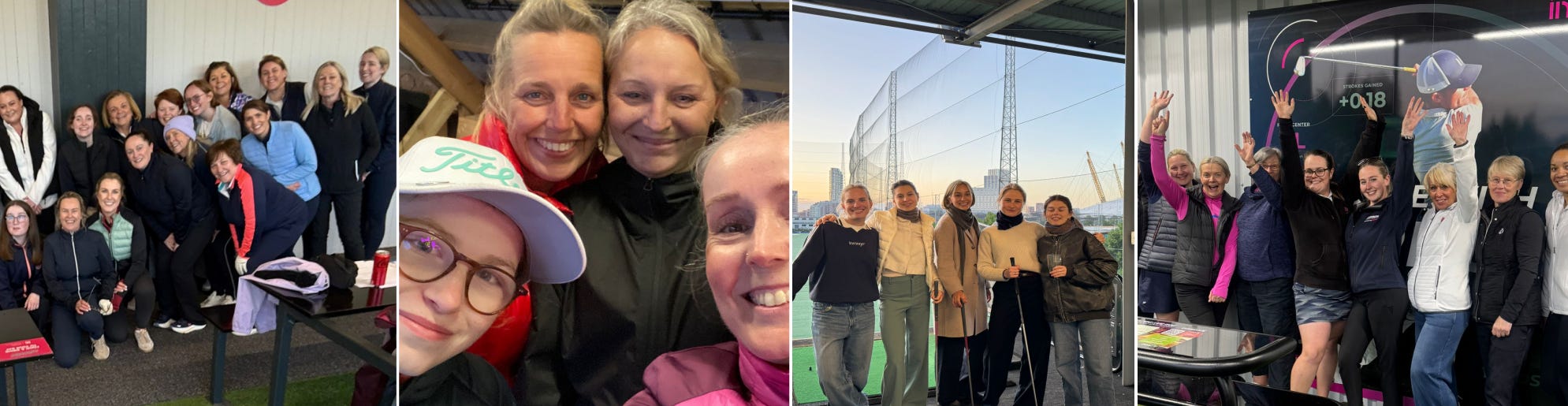
Eight women who barely knew each other turned up at a Dublin range one evening. None came for the technology. Within an hour, they were a team, chasing each other up a leaderboard and booking the next night before they’d left. That single evening is now a series running across eight venues in four countries, with close to 300 women competing on the same leaderboards on the same nights. The operator takeaway isn’t the headcount — it’s the cause. The range didn’t grow because it bought clever tech. It grew because the tech got out of the customer’s way and let her build something the venue could never have programmed on its own.
That customer was Suzanne Thompson, who launched Swing & Tonic to fix a problem most ranges quietly tolerate: the bay is built for the solo, male, regular golfer, and intimidating to everyone else. Running on Inrange, her venue handed her the platform, the bays, and the F&B, then stepped back. Team plays, and bay-vs-bay competition meant the nervous first-timer was never alone on the line, and a whole cohort could be pulled in at once — across venues, on one shared leaderboard. For the operator, that isn’t a softer story about inclusion. It’s repeat visits, fuller bays, F&B spend, and a recurring event that fills the calendar. And the market math is hard to wave away: the NGF puts the growth of the female golfer pool at 45% in six years, the fastest-moving segment in the game. The women are arriving. Most ranges still aren’t built to keep them.
Here’s the line operators should sit with. Most range technology is bought to keep traditional golfers happy. The venues that win the next decade will run tech that serves the golfer and the entertainment customer — and, better still, hands the best of those customers the tools to grow the business for them. Inrange didn’t manufacture the Swing & Tonic series; it made it possible, then got out of the way. So before the next technology decision, one question outranks the spec sheet: does the tech you’re installing empower your customers to grow your business for you? The ranges that can answer yes won’t be chasing the fastest-growing segment in golf. They’ll already have it.
For more information on Inrange® Golf, visit their website and follow them on LinkedIn for the latest news and product innovations from their team.
THE BELFRY UNVEILS ACTIVE-TERRAIN PERFORMANCE SUITE WITH ZEN GOLF
The Belfry Hotel & Resort has unveiled what is believed to be Europe’s first active-terrain golf performance suite, combining ZEN Golf’s dynamic playing surfaces with Trackman integration inside the VIP Studio at The PGA National Golf Academy.
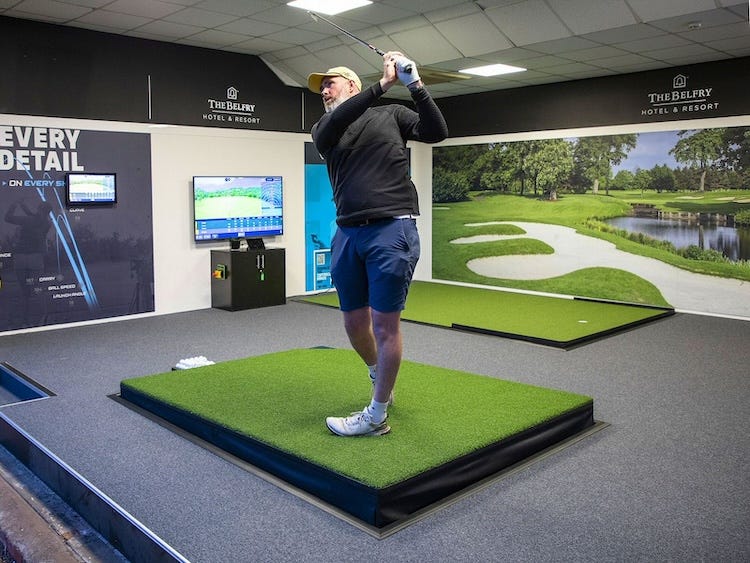
The installation brings together a new ZEN Green Stage with the Academy’s existing ZEN Swing Stage, allowing coaches, fitters, and players to work across breaking putts, uneven lies, and changing slopes within a single performance environment. By linking ZEN Golf’s programmable terrain technology with Trackman ball-flight analysis, the facility is designed to narrow the gap between practice and on-course performance, with Zen Eye and the Putting Index also set to be added to create a wider system of active terrain, launch monitor data, putting analysis, and immersive player feedback.
Chris Reeve, Director of Golf and Leisure at The Belfry, said the VIP Studio had become “a truly unique coaching environment” where players can experience conditions closer to those found on the course, while Dan Warwick, Head Professional at The PGA National Golf Academy, said the two stages allow coaches to “coach more of golf, more naturally, within a single environment.” David Colclough, Head of Coaching & Sport Science at The PGA of Great Britain & Ireland, said the installation creates “an exciting environment where coaching, research and innovation come together,” while ZEN Golf founder Nick Middleton said The Belfry is showing how indoor golf is moving beyond measuring ball striking towards recreating “the conditions under which every shot is actually played.”
U.S. GOLF ROUNDS STAY AHEAD OF RECORD 2025 PACE
U.S. golf rounds were up 5.6 percent nationally in May 2026 compared with the same month last year, according to the latest National Rounds Played Report from Golf Datatech and the National Golf Foundation.
Year-to-date play through May is now 5.4 percent ahead of 2025’s record-setting pace, helped by more golf-friendly temperatures and precipitation after a wetter, cooler May last year, when national rounds fell nearly 2 percent. The strongest May gains included Iowa and Missouri at 28.7 percent, New Jersey at 16.1 percent, Pennsylvania at 12.6 percent, New York at 12.0 percent, New England at 11.7 percent, Illinois at 11.0 percent, and the Maryland, Delaware, and Washington, D.C. region at 11.0 percent.
GOLF ROUNDS FALL FROM RECORD 2025 LEVELS ACROSS THE UK
Golf rounds played per course across Great Britain fell 14.5 percent year on year in the first quarter of 2026, according to Sporting Insights, although the comparison was against a record-breaking 2025, and Q1 activity remained slightly ahead of 2024.
March 2026 offered a more encouraging signal, ranking as the second strongest March of the past five years, with participation still building into the traditional golf season and supported by continued growth in golfer numbers. Sporting Insights noted that year-round engagement is also being helped by indoor simulator venues and technology-enabled driving ranges, which are reducing the impact of poor weather on parts of the golf ecosystem. “2025 was a record year for rounds played, so some drop off was not unexpected, especially given long spells of wet weather,” said John Bushell, managing director of Sporting Insights, adding that the March figures were “solid” ahead of half-year data due in July.
GOLF TRAINING AIDS MARKET FORECAST TO REACH US$1BN BY 2032
The global golf training aids market was valued at US$782.2 million in 2025 and is forecast to reach US$1.0 billion by 2032, growing at a compound annual rate of 3.8 percent, according to new market analysis by ResearchAndMarkets.com.
Growth is being driven by wider access to golf analytics, online coaching, virtual lessons, home-practice products, e-commerce, and direct-to-consumer brands, with AI-powered swing analyzers, smartphone-linked tools, motion tracking, and sensor-enabled devices making training aids more interactive and data-led. The swing trainer segment is expected to reach US$358.6 million by 2032 at a 3.3 percent CAGR, while hitting nets are forecast to grow at 3.0 percent, supported by demand from amateur golfers, junior academies, driving ranges, golf academies, corporate wellness programs, and players seeking portable, multi-function practice products.
Regionally, the U.S. market was valued at US$242.0 million in 2025, while China is projected to grow at a 6.9 percent CAGR to US$238.4 million by 2032, with further growth trends identified across Japan, Canada, Germany, and the wider Asia-Pacific region.
TGR DESIGN TO BUILD NEW CHAMPIONSHIP COURSE AT TRIBUTER RESORT
Tributer Resort, the golf and residential destination being developed by Reef Capital Partners on Virginia’s Lake Anna, has announced plans for a new private 18-hole championship course designed by Tiger Woods’ TGR Design.
The course will be the resort’s second championship golf experience, joining Cutalong Golf Club, and will measure 7,310 yards from the championship tees while being routed through rolling farmland, hardwood forests, and pine groves overlooking the lake. TGR Design said the layout will use generous fairways, strategic hazards, and undulating greens to challenge elite players while remaining playable for a wider range of golfers. “Lake Anna provides a remarkable setting for championship golf, and we’re excited to see this design come to life in a way that fully reflects its sense of place,” said Bryon Bell, President at TGR Design, while Cutalong Golf Club was recognized by Golf Digest in 2023 as one of the Top 5 Best New Private Courses in the United States.
KPMG WOMEN’S PGA ADDS AI TO PERFORMANCE DATA AND BROADCAST COVERAGE
The 2026 KPMG Women’s PGA Championship at Hazeltine National Golf Club is being positioned as the most technology-driven event on the LPGA Tour, with KPMG adding AI-enhanced player reels, real-time shot-level data for media, and a live outcome prediction engine to KPMG Performance Insights.
KPMG CHAMPCAST will use ShotLink Pro technology for the third consecutive year, offering 3D imagery, radar data, shot trails, green views, and individual shot video highlights, while nearly 100 hours of live, streaming, and ancillary coverage will run across NBC, Golf Channel, and Peacock, with expanded Featured Groups powered by T-Mobile and several caddies mic’d up for the first time. The field, which is playing for the highest recorded purse of $13 million this week, includes all top 100 players in the current Race to CME Globe rankings, with 156 players competing at Hazeltine, which will become the first American course to host the Ryder Cup twice when it stages the event again in 2029.
Tim Walsh, KPMG U.S. Chair and CEO, said the Championship is combining “a record purse with technology that gives players better, real-time insight into their performance,” while PGA of America CEO Terry Clark and LPGA Commissioner Craig Kessler said the event reflects continued investment in women’s golf through prize money, technology, broadcast coverage, and one of the strongest fields of the year.
112 MILLION PEOPLE ARE PLAYING GOLF. NOW COMES THE HARD PART
The easiest thing to do with The R&A’s latest global participation report is to celebrate the headline number.
Across The R&A’s affiliated markets, excluding the USA and Mexico, 112.2 million adults and juniors are now playing golf in some form. That is up from 108 million in 2024 and represents another year of growth for a sport that continues to enjoy a post-pandemic participation tailwind.
For golf’s governing bodies, that is an encouraging number. For the wider industry, it should also be a challenging one.
Because the most important question raised by the report is not whether golf is growing. It is who is actually benefiting from that growth.
Look more closely, and the report tells a more complicated story. Of those 112.2 million participants, 43.9 million are 9- or 18-hole golfers. Only 8.7 million are registered golfers. Total adult participation stands at 65 million, while total junior participation has reached 47.1 million. The gap between those numbers is where the business story sits.
