


HOW TO SUBSCRIBE:
Golf Bizz Review is made possible by the support of its readers and by carefully selected partnerships that sustain our independent editorial work. If you would like to experience the full depth of GBR — and support thoughtful, long-term coverage of the global golf industry — you can subscribe here.
HOW TO PARTNER WITH US:
If you are interested in contributing to and strengthening our content offering as a partner, company, or institution, we would be pleased to hear from you at newsroom@golfbusinessreview.com.
MANAGE YOUR SUBSCRIPTION: If you no longer wish to receive our emails, you can unsubscribe here.
Hello GBR,
What a difference a year makes.
The Topgolf Callaway group was under severe strain this time last year. Regardless of the success of Callaway’s equipment lineup, the shine was taken off by the ongoing struggles of the Topgolf business, especially from their existing venues.
Topgolf was sold to Leonard Green & Partners in November last year (majority sale), so would the sale payoff? Would Callaway’s figures improve or decline? Going by the first quarter of 2026, the decision looks to have paid dividends (a poor pun), as Callaway has posted some healthy numbers driven by the new Quantum range, and storong international success.
Paid subscribers have full access to our indepth analysis of what the figures tell us, if you haven’t subscribed to GBR yet, please do so to get the full picture and have a say in how we develop the publication going forward.
Enjoy today’s GBR and if you’re watching, the PGA Championship this weekend.
NEWTON GOLF Q1 REVENUE FALLS AS MANUFACTURING TRANSITION DELAYS SHIPMENTS
Newton Golf reported first-quarter 2026 revenue of $1.0 million, down 18% from $1.2 million a year earlier, after temporarily reduced manufacturing capacity and delayed order fulfillment affected shipments during operational initiatives intended to support future growth. Gross profit fell to $628,000, or 63% of net sales, from $852,000, or 70%, while operating expenses rose 15% to $3.2 million and net loss widened to $2.7 million, or 58 cents a share, from $0.5 million, or 5 cents a share. At quarter end, Newton said it held $0.9 million in direct-to-consumer customer deposits and $0.3 million in open wholesale sales orders, representing $1.2 million of expected future revenue as delayed orders begin to ship.
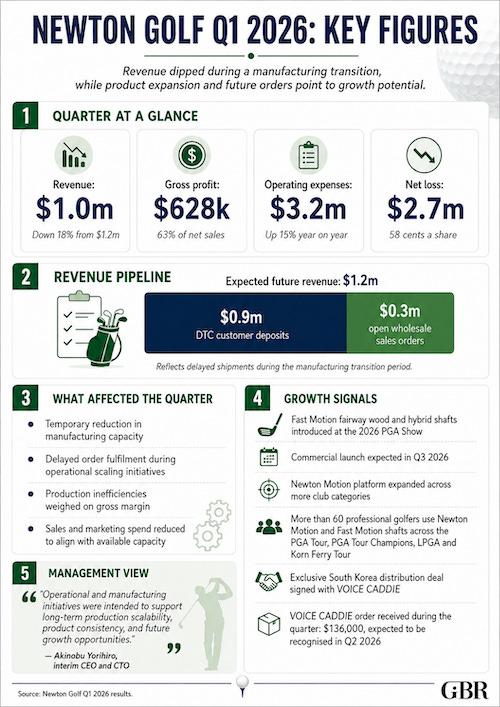
Interim chief executive and chief technology officer Akinobu Yorihiro said the quarter’s disruption reflected investment in long-term production scalability, product consistency, and broader channel growth, with a new head of manufacturing hired in April to strengthen operational execution. The company also used the period to expand the Newton Motion platform, having introduced Fast Motion fairway wood and hybrid shafts at the 2026 PGA Show, with commercial launch expected in the third quarter of 2026. Newton said the products extend its DOT fitting system across more of the bag, while more than 60 professional golfers now use Newton Motion and Fast Motion shafts across the PGA Tour, PGA Tour Champions, LPGA, and Korn Ferry Tour. The company also signed an exclusive South Korea distribution agreement with VC Inc. (VOICE CADDIE) and received a $136,000 order in the quarter, which it expects to recognize as revenue in the second quarter.
PGA AND 59CLUB RENEW PARTNERSHIP FOR AN ADDITIONAL THREE YEARS
The PGA of GB&I has renewed its long-standing partnership with 59club for a further three years, extending a relationship that began in 2010 and now spans 15 years.
Founded in 2008 by PGA Master Manager Simon Wordsworth, 59club has grown into a global performance-management business working with more than 1,200 golf and leisure venues, spas, hotels, retail operations and food-and-beverage outlets, using tools such as satisfaction surveys, mystery shopper audits, financial comparison data and employee training to improve service, sales and staff development.
Under the renewed deal, PGA Members will continue to have access to surveys, mystery shopper audits, masterclasses, PGA Monthly content, PGA Learn resources, and the Annual Service Excellence Awards, while PGA Branded Properties will receive up to four mystery shop visits a year, tailored analysis, bespoke staff training, and access to 59club Mentor, its online training and asset-management platform.
Duncan Rougvie, Head of Commercial at The PGA, said the partnership remained “progressive and aligned”, while Wordsworth said it would continue to support PGA Professionals as their roles become “broader” and “more commercially focused”.
SWAG GOLF JOINS TROON PARTNERS NETWORK AS PREFERRED PARTNER
Troon Partners Network has named SWAG Golf and its family of brands as its newest Preferred Partner under a multi-year agreement that will bring SWAG events and products to Troon golfers across the U.S.
The deal will see SWAG headcovers and other merchandise stocked in Troon pro shops, while the company and its related brands will also receive feature placement through Troon’s Shopify Collective to reach high-value consumers across the operator’s network. SWAG’s brand portfolio includes SWAG, which produces bespoke headcovers, bags and coolers for clubs and events; EP, which focuses on fully customisable shop items; Hometown Brands, which offers officially licensed accessories across the NFL, NHL, MLB and NCAA; and Rewind Golf, which makes officially licensed accessories tied to titles including Happy Gilmore, Ace Ventura, The Big Lebowski, Tommy Boy and Caddyshack.

“We are thrilled to welcome SWAG Golf to the Troon Partners Network,” said Ryan Pensy, Vice President of Strategic Partnerships at Troon Partners Network, while Griffin Glatt, Chief Revenue Officer of SWAG Golf, said the partnership would help deliver the brand’s distinctive styling and product line-up to a wider golf audience.
THE REVENUE CLUB ADDS 65 NEW COURSES IN EARLY 2026 AS DIGITAL GOLF DEMAND GROWS
The Revenue Club said it added 65 new golf courses to its partner network in the first four months of 2026, taking its client base to more than 300 courses across the UK and Ireland.
More venues are looking to strengthen their online visitor operations through revenue management and digital marketing. The business, which describes itself as the UK’s leading growth agency for golf, said the latest intake includes both private members’ clubs and higher-volume proprietary venues, with demand centered on its dynamic pricing strategies, CRM-led customer lifecycle management, and wider digital sales support. Its recent growth was accompanied by inclusion in the 2026 Martech 50, BusinessCloud’s annual ranking of the UK’s most innovative marketing technology creators. “Golf clubs are realising they need to go beyond a simple booking engine; with intelligent pricing structures and creative online marketing to realise a healthy ROI from their digital channels,” said co-director Chris Knight, while fellow co-director Rob Corcoran said the early-2026 growth had exceeded expectations and reflected a wider shift toward a “more modern, commercial approach” as clubs seek to diversify income and protect themselves against changing economic conditions.
FIVE IRON GOLF LAUNCHES REAL-MONEY TOURNAMENT PLATFORM ACROSS U.S. NETWORK
Five Iron Golf has launched Five Iron Tournaments, a real-money indoor golf competition platform rolling out across 15 markets in 11 states plus Washington, D.C., with further expansion planned by late summer 2026.
The new platform allows players to enter tournaments on demand from any participating bay, compete on live leaderboards for prize money, and choose formats including stroke play, scramble, and closest to the pin, with many events free to enter and hundreds of thousands of dollars in guaranteed prize pools scheduled through 2026. Five Iron said the launch builds on its growth from a four-simulator concept in New York’s Flatiron district into a business with more than 50 locations across seven countries, over 500 Trackman simulators, more than 800 employees, and backing from investors including Callaway and Enlightened Hospitality Investments.
Since the beta launch in October 2025, more than 1,000 players have recorded nearly 20,000 tournament entries, with 65% returning within the same month to play again. “We’ve built a platform that makes competition continuous, flexible, and accessible, while still rooted in real skill and real play,” said chief executive Jared Solomon. Markets in the first phase include New York City, Chicago, Boston, Detroit, Atlanta, Washington, D.C., Indianapolis, Las Vegas, Seattle, and venues across Florida, Kentucky, and Ohio, with Baltimore, Minneapolis, and Oklahoma to follow; a closest-to-the-pin series will run from June 1 to June 30 across 20 tournaments on well-known courses with $20,000 in guaranteed prize pools.
OLD PETTY OPENS AT CABOT HIGHLANDS AS SITE EYES MAJOR TOURISM LIFT
Cabot Highlands has officially opened the new Old Petty course, the Tom Doak-designed layout, situated near Inverness, has gone straight into Scotland’s latest Top 20 rankings at No. 20.
The Old Petty is designed to encourage strategic and creative links golf, with the routing drawing in Highland landmarks including Castle Stuart and Auld Petty Church, and using the site’s natural terrain to shape play. Among its distinctive features are sweeping coastal views and an uncommon design detail in which the 1st and 8th holes criss-cross, a rare feature in modern course architecture.
The addition of Old Petty alongside Castle Stuart is expected to strengthen both Cabot Highlands and golf tourism in the wider region, with general manager Mark Wright previously saying the development should benefit not only the resort but also Inverness and the Highlands more broadly as visiting golfers use the site as a base to play courses such as Nairn, Royal Dornoch, Brora, and Tain. Cabot Highlands currently sells between 20,000 and 25,000 rounds a year at Castle Stuart, with the total now expected to move towards 50,000 rounds annually with Old Petty in operation.
PGA TOUR ASSURES DP WORLD TOUR OF CONTINUED FINANCIAL SUPPORT THROUGH 2032
The PGA Tour has sought to reassure Rory McIlroy and other European players that it will continue backing the DP World Tour financially.
Chief executive Brian Rolapp is understood to have given verbal assurances that support will remain in place until 2032 as the tours renegotiate their strategic alliance.
The existing deal, struck in 2021, has already seen the PGA Tour invest $85 million (£63 million) for an initial 15% stake in European Tour Productions, later increased to 40%, while also underwriting DP World Tour prize funds so that no individual event falls below $3 million, a commitment that has reportedly cost the Americans tens of millions of dollars each season. The arrangement is expected to be rewritten on terms more favorable to the PGA Tour, which originally entered the partnership partly to prevent Saudi-backed involvement with the European circuit.
Concerns over the DP World Tour’s future have intensified amid uncertainty around LIV Golf’s long-term funding, with Ian Poulter warning that the European tour could be vulnerable if LIV collapses after the Saudi Public Investment Fund’s planned withdrawal. McIlroy, a long-time supporter of the DP World Tour, was present when Rolapp gave the assurances at Quail Hollow, and his influence is seen as significant as the PGA Tour weighs the value of a partnership that has also provided a route for the top 10 non-exempt DP World Tour players to earn PGA Tour cards each year. James Corrigan’s full article for the British Telegraph can be read here.
THE TITLEIST GTS DRIVER RANGE REVEALED
Titleist has confirmed that its new GTS2, GTS3, and GTS4 drivers will go on sale on June 11.
Following social media activity generated from an early tour release that has already seen more than 50 PGA Tour players put one of the heads into play since the lineup debuted at the Texas Children’s Houston Open, including Justin Thomas and Jordan Spieth, the anticipation of what the new lineup will offer has been strong.
GTS fairway woods also form part of the launch, but for today, we’ll concentrate on the drivers. At the center of the new range is a Split Mass Frame combined with a full thermoform body made from Titleist’s Proprietary Matrix Polymer (PMP), with PMP content increasing from 13 grams to 26 grams compared with the previous GT generation to free up more discretionary mass. Titleist says that allows weight to be moved both rearward for more stability and forgiveness and low-forward for speed, launch, and spin control, while an updated aerodynamic shape, including raised tail sections on the GTS2 and GTS3, is designed to reduce drag and increase clubhead speed.
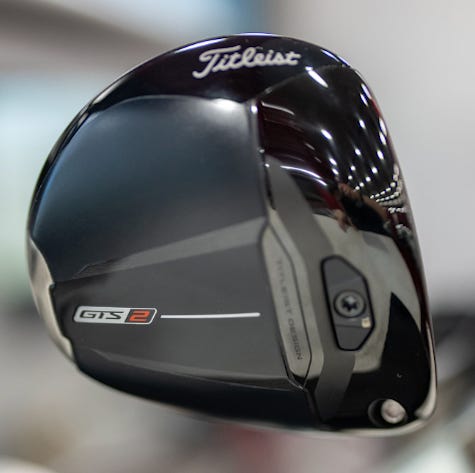
The drivers also feature a new Speed Sync Face, engineered to retain ball speed across a wider impact area through a reinforced perimeter, an opened-up upper support ring to help on high-face strikes, and variable face thickness. All three models include expanded adjustability, with GTS2 using interchangeable forward and rear weights and GTS3 and GTS4 combining a rear weight with a forward track system, while new high-contrast face graphics are intended to improve alignment at address. In the range, GTS2 is the most forgiving, higher-launching head with mid spin and a larger profile; GTS3 is a more compact, deeper-faced option built for players seeking lower launch, lower spin, and more shot-shaping control; and GTS4, still the lowest-spinning model, now moves to a full 460cc profile to add more forgiveness while retaining its low-spin design.
The drivers are available for fittings and pre-sale now, priced at $699 standard and $899 premium for customized shaft options outside the Titleist range.
CALLAWAY Q1 2026: STRONG CLUB SALES, HIGHER MARGINS, AND A BETTER START TO THE YEAR
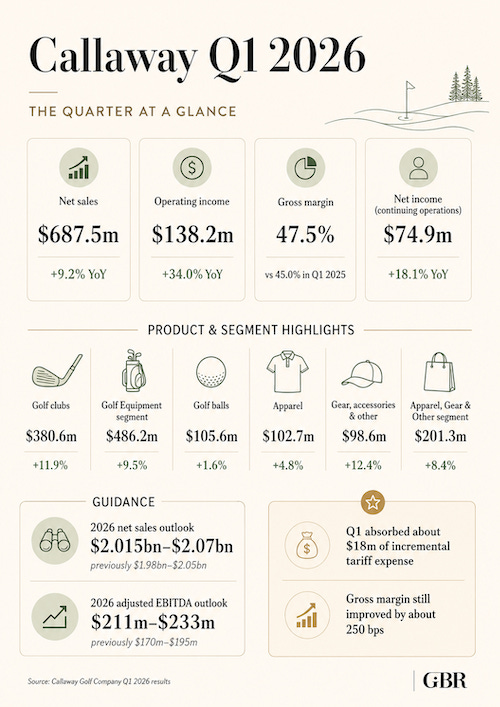
Callaway’s first-quarter figures point to a business that has opened 2026 well. Sales were up, clubs led the growth, margins improved, and management raised its expectations for the full year. On the face of it, that is the story. Revenue from continuing operations rose 9.2 percent to $687.5mn, while gross margin improved to 47.5 percent from 45.0 percent a year earlier. Callaway also lifted its full-year net sales outlook to $2.015bn-$2.07bn.
Chip Brewer, Callaway’s president and chief executive, described it as “a strong start to the year”, saying the result reflected “strong demand for our new products” and progress on gross margin and cost-saving initiatives. He also added a note of caution, saying some of the first-quarter results benefited from timing between quarters.
That matters because it stops the quarter from being overstated. The message is not that every question around the year has been answered in April. It is that the opening months have gone well enough for management to raise guidance, and that is usually worth taking seriously.
The quarter was shaped primarily by clubs, where Callaway’s new Quantum launch appears to have given the business its clearest push. Golf club sales rose 11.9 percent year on year to $380.6mn, helping drive a 9.5 percent increase in Golf Equipment revenue to $486.2mn. Elsewhere, growth was more measured: golf balls rose 1.6 percent, apparel 4.8 percent, and gear, accessories, and other products 12.4 percent.
That distinction matters because it shows where the quarter genuinely improved. This was not a case of every category moving sharply higher at once. The strongest momentum came from the area of the business most closely tied to Callaway’s latest equipment cycle.
That is relevant because it keeps the piece anchored in what the business really is. Callaway’s quarter was, above all, a product story. Its latest technology cycle in the Quantum range appears to have helped produce a stronger opening to the year, at least in clubs, and management explicitly pointed to demand for new products in explaining the result.
There is no need to push that into a broader claim than the evidence allows.
The filings do not prove that one launch has beaten every rival launch in the market, and they do not need to. What they do show is that Callaway’s new-product cycle supported a stronger quarter in equipment than the company managed in the same period last year. In Q1 2025, the equipment business grew less impressively inside the wider group, with golf equipment revenue down 1.4 percent.
The contrast with Q1 2026 is clear enough.
The regional picture makes the same point in a different way. The US remains the main engine of the business, with sales up 7.9 percent to $448.8mn. Europe was stronger, with revenue up 29.4 percent to $83.2mn, or 18.2 percent in constant currency. Asia was softer, down 3.0 percent on a reported basis and 0.7 percent in constant currency. The rest of the world rose 22.4 percent, though from a smaller base.