

GBR Friday | U.S. OPEN ECONOMICS AT SHINNECOCK: 59CLUB F&B DATA AND ZEN GOLF’S PLAYABLE PUTTS
From Shinnecock’s U.S. Open economy to 59club’s F&B insight and Zen Golf’s Green Stage software, GBR looks at the money, service and technology stories shaping golf this week.

HOUSEKEEPING BEFORE WE START: Golf Business Review is made possible by the support of its readers and by carefully selected partnerships that sustain our independent editorial work. If you would like to support independent, long-term coverage of the global golf industry — and access the full GBR archive — subscribe here.
HOW TO PARTNER WITH US: If you are interested in contributing to and strengthening our content offering as a partner, company, or institution, we would be pleased to hear from you at newsroom@golfbusinessreview.com.
Hello GBR,
With the action underway at Shinnecock Hills, day one didn’t produce the strong winds that were expected, will that change today? Early indications are showing Shinnecock is pretty scoreable at the moment.
While the action is underway on the course, we are looking at the action off the course in the form of the economic story of the U.S. Open and how much money now moves around a major championship.
From there, we look at 59club’s latest F&B performance insight and the small service habits that can make a measurable commercial difference. We also cover Zen Golf’s new playable putting moments, AI-powered game tools, irrigation savings, Topgolf expansion and the latest turn in golf’s distance debate. As ever, the thread is the same: where the business of golf is changing, and what clubs, venues and operators can learn from it.
If you’re going to Shinnecock, or simply watching it on TV, have a good time.
My attention is diverted from the golf this evening as Scotland takes on Morocco in Boston tonight.
Enjoy today’s edition of GBR.
The F&B Upsell Starts Before the Bill Arrives
In the latest article from Golf Business Review’s educational partnership with 59club, we look at how customer-experience data, mystery shopper insight and best-practice learning can help clubs identify practical ways to improve performance.
For golf clubs, standing still is rarely an option. As member expectations rise, guest behaviors change, and operating costs remain under pressure, the ability to identify small improvements across the customer journey can have a meaningful impact on satisfaction, loyalty, and commercial performance.
This latest 59club insight focuses on F&B performance and how better service habits can influence both the customer experience and the commercial result. From the quality of the personal connection between server and diner to the ability to make timely, relevant recommendations, the data points to an important lesson: the upsell opportunity is often built long before the bill arrives.
Increase Your F&B Performance
Our three main data sources are all reaching the same conclusion:
namely that clubs can increase their revenues with better service levels
Insights collected from universal club member surveys indicate that customer service within the F&B operation is rated at 85 percent across 59club’s podium performers, with the 59club industry average at 75 percent.
Powering The Upsell Engine
However, one story starts to unfold as we unravel the data, which indicates that the tactic most in need of improvement across all non-affiliated properties is also the least costly and also happens to be a catalyst for increased margins – the upsell engine.
The Personal Connection
Customers are more likely to purchase additional or premium items when they have a personal connection with their server. A friendly conversation can be the difference between your customers ordering the least profitable items on the menu or, on recommendation, opting for the higher return options.
Rapport Gets Results
Developing rapport is a tactic that every server should strive for and that every manager should develop and encourage when working with their team.
Data shows that 59club’s podium performers are way above the industry average in this area, while non-59club-affiliated properties are losing money hand over fist on their food offering, with less than one in six diners offered additional items when they are at the point of ordering meals.
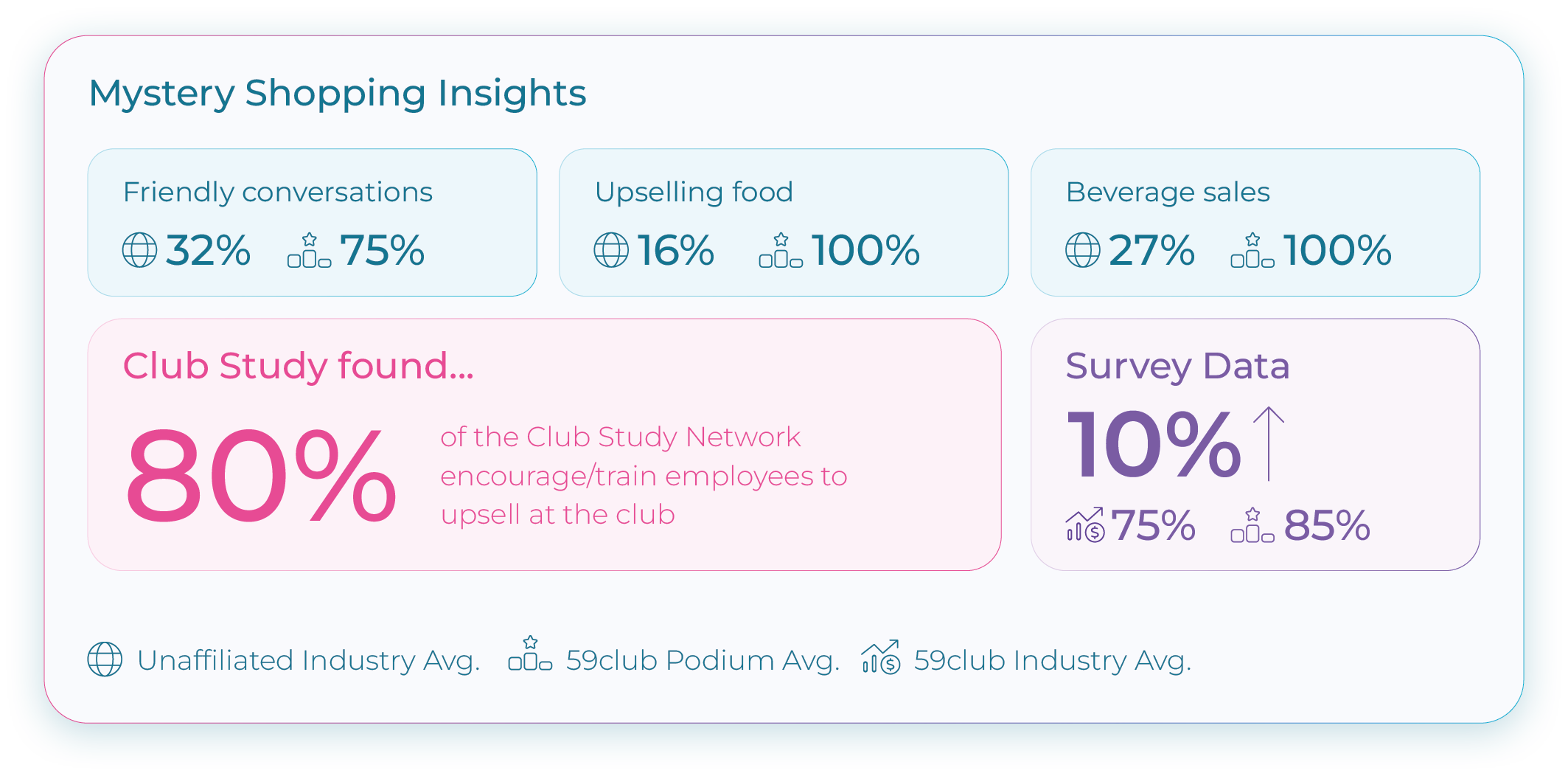
Key Takeaway
The clear lesson to the wider industry is to train and encourage employees to begin implementing those friendly conversation starters. Prioritizing upselling as a tactic to increase sales will pay dividends – and in doing so, you can be confident that your profit margins will start soaring too.
59club helps clubs see their operation through the eyes of members, guests, and visitors, and turn that insight into measurable improvement.
For venues looking to strengthen their performance, improve service standards and identify where additional revenue opportunities may be missed, 59club’s data-led approach offers a practical starting point.
Through mystery shopping, benchmarking and best-practice learning, 59club helps clubs understand not only what customers experience, but where small changes in service behavior can make a measurable commercial difference.
To learn how 59club can support your venue, contact the 59club team here: www.59club.com
ZEN GOLF BRINGS ICONIC PUTTING MOMENTS TO GREEN STAGE SOFTWARE
Zen Golf has launched a new Famous Putts playlist that allows Green Stage owners to recreate some of golf’s most memorable putting moments inspired by events this week at Shinnecock Hills.
The playlist features Zen Golf’s independent recreations of historically significant putts, based on publicly available information and Zen’s own technology, and is designed to identify the sporting moments that inspired each playable challenge.
The playlist has been developed independently by Zen Golf, using publicly available information and its own technology, Zen’s patented Active Terrain Technology, to recreate the putting moments that inspired each challenge.
Each putt has been recreated to give golfers the chance to experience the slopes, pace and contours faced by major champions at clutch moments spanning six decades, starting with Ken Venturi’s 10-foot par putt in 100-degree heat at Congressional in 1964 to Bryson DeChambeau’s five-foot championship-winning par putt at Pinehurst No. 2 in 2024, and including famous putts from Payne Stewart, Tiger Woods, and Jon Rahm.
While the challenge brings a strong element of fun, emulating some of the greatest players in the game, the challenge is also educational in helping players develop better green reading, pace control, and stroke execution skills.

Will Stubbs, Head of Education at Zen Golf, said: “Watching great golf is inspiring. Playing those same moments is transformational.” He added that the release shows how software is becoming “just as important as hardware,” allowing courses, coaches and golfers to access an expanding library of playable experiences. The playlist forms part of Zen’s wider software platform, which already includes major championship recreations, coach-created practice environments and interactive challenges, with future releases set to integrate with Zen Eye, Putting Index and Play Live Golf.
TOPGOLF TO OPEN THIRD NEW JERSEY VENUE
Topgolf will open its newest venue in Parsippany, New Jersey, less than 30 miles west of New York City. The venue will be Topgolf’s third location in New Jersey, joining Edison and Mount Laurel, and its 102nd in the United States, with new entertainment and technology features including arcade games, a reimagined outfield target and slope, and “My Bay, My Way,” which allows guests using the Topgolf app to customize their bay experience from their phone. Topgolf Parsippany will also include 24 dedicated game-day suites, compared with the two typically offered at existing venues, each fitted with multiple surround screens for panoramic viewing. “We’re thrilled to debut the latest Topgolf sports and entertainment concept to Parsippany, expanding our presence in New Jersey,” said David McKillips, Topgolf CEO, adding that the venue expands the company’s entertainment and technology offer for guests and players “of all ages and skills.”
SCOTTISH START-UP TARGETS GOLF’S AGEING IRRIGATION PROBLEM
Irrigate App, a Scottish start-up, has secured £100,000 in the latest Scottish EDGE funding round for retrofit technology designed to help golf clubs upgrade aging irrigation systems without the cost and disruption of full replacement.
With an estimated three-quarters of UK golf courses operating irrigation systems at or beyond their typical design life, the company uses wireless IoT cellular controls, solar power and app-based software to manage existing valves without long trenching, expensive PCs, connectivity hubs or hardware networks. In some instances, the Irrigate App can save up to 30 percent of water, reduce annual bills by £5,000 ($6610) to £10,000 ($13,215), cut labor by half to one full-time equivalent, and potentially deliver £25,000 ($33,040) to £30,000 ($40,000) in annual savings with payback in 12 months.
The system also captures live and future weather data every hour for each GPS position on the course, using factors such as evaporation rates to recommend watering levels, while extending asset life, reducing copper wiring runs and supporting better playing surfaces, with one client reporting a green fee income increase of more than 20 percent after deployment.
BLUE TEES GOLF ADDS AI-POWERED INTELLIGENCE TIER TO GAME APP
Blue Tees Golf has released GAME 1.15.2, adding a new Intelligence Tier to its app, which is available on iOS and Android through an in-app upgrade.
The tier includes all features from the Core Tier, formerly Premium, alongside Scout AI™ Virtual Caddie for real-time shot guidance based on club distances, course layout and environmental conditions, AI Post-Round Analysis with estimated strokes gained, and Satellite View for high-resolution course imagery. The update is designed to help golfers plan, play, review and improve by providing personalised round summaries, performance patterns, “what went right/what went wrong” highlights and AI-driven recommendations. “The biggest challenge in golf isn’t collecting data—it’s turning it into something useful,” said Michael Novotny, Director of Software Product Management at Blue Tees Golf, adding that the Intelligence Tier gives players “a clear picture of where they’re gaining and losing strokes and what to work on next.”
USGA AND R&A TO REVIEW DISTANCE OPTIONS AHEAD OF 2030 BALL STANDARD
The USGA and R&A will proceed with a new golf ball distance standard in 2030 while widening their review of other measures that could limit distance gains at the elite level.
The revised Overall Distance Standard will test balls at a 125mph swing speed, up from 120mph, while keeping the distance limit at around 317 yards, with the governing bodies opting for a single 2030 implementation date after initially planning a 2028 start for elite players. In a joint statement with the PGA Tour and DP World Tour, the organisations said they would work with “key stakeholders” and tour members to “review, test and implement options that have a meaningful impact on distance at the elite level.” USGA chief executive Mike Whan said some ideas previously set aside because of tour feedback may now be reconsidered, with the debate sharpened by Cameron Young’s use of a lower-spinning Titleist ball that met the new test standard but did not reduce distance, including a 375-yard final tee shot when he won The Players Championship.
Who Gets Paid When The U.S. Open Comes To Town?
By the time you read this, round two of the U.S. Open will be well underway at Shinnecock Hills. But beyond the golf itself, another story is already unfolding across Southampton: the movement of money through one of the sport’s most powerful temporary economies.
Across Southampton, money is already moving. Hotels and private rentals have captured tournament-week demand. Restaurants, transport providers, and local service businesses are working through the surge. Inside the gates, fans are buying food, drinks, and merchandise. Corporate guests are being hosted in temporary suites. Broadcasters are turning the course into live content. Local authorities are managing the public burden of a major event. And by Sunday evening, one player will leave with a $4.5 million winner’s cheque.
The question is not whether the U.S. Open is big business. The question is who benefits from it, who pays for it, and what Shinnecock reveals about the modern economics of major-championship golf.
That is the more useful way to understand this week. The U.S. Open is still one of golf’s great competitive examinations. At Shinnecock Hills, that identity carries particular weight. The course brings history, difficulty, architectural credibility, and a certain old-world seriousness that the USGA continues to value. But the championship around it has changed.
Shinnecock is the constant. The business model is what has expanded.
For one week, the club becomes a temporary marketplace. Not metaphorically, but practically. A private golf course is converted into a working commercial system: ticketed entry, hospitality compounds, merchandise retail, food-and-beverage operations, broadcast infrastructure, security, transport, sponsor activation, volunteer management, and public-service coordination. The championship may be decided by golf, but it is delivered through logistics and monetized through access.
The scale is easy to underestimate because golf still presents itself through tradition. The visual language is familiar: fairways, grandstands, flags, leaderboards, players, galleries. But behind the tournament image sits a much larger economic machine.
The clearest recent benchmark is Oakmont. The 2025 U.S. Open generated a reported $288.8 million in economic impact for Pennsylvania, including more than $200 million in Allegheny County. More than 200,000 players and spectators were involved across the week.
