

GBR Friday | The Players Has the Field — But Does It Have the Economic Power of a Major?
Connecting the dots across golf’s business, media, and professional landscape

Hello GBR,
The Players Championship is well into round two as I write this. Rory McIlroy may well make the cut, but Collin Morikawa didn’t last the second hole of his first round. Withdrawing after a practice swing on the 11th tee ended his week prematurely.
In the run-up to this week, there was a lot of talk around The Players elevation to major status. It’s not the first and won’t be the last time the debate rages over where The Players should sit in the pantheon of world golf.
So, it got me thinking, The Players stacks up against the majors in terms of the quality of the field and the prize money on offer. But, does it carry the same economic weight as the majors, and should that be a metric to be considered when weighing up whether The Players becomes the fifth major?
You can read in more detail where The Players sit on the economic scale in our big read.
Elsewhere, we cover a new white paper from Maximize Market Research, which projects the golf equipment market to be worth over $12 billion by 2032.
We’ll also check in on a new course development in South Carolina, which is the only public course out of a total of nine that are currently in development in the region.
Golf clubs need to take better care of long-term capital planning in order to thrive going forward. That’s the view of an industry expert and current CEO of a club in the UK. Do you agree with his views, or is there more to it than just managing the finances effectively?
In the market for new wedges? PXG might have the answer with their new Stick’em wedges.
Enjoy today’s GBR, and have a great weekend.
REPORT SEES GOLF EQUIPMENT MARKET GROWING TO $12.65 BILLION BY 2032
A new report from Maximize Market Research indicates that the global golf equipment market is being reshaped by advances in materials science, artificial intelligence, and the continued expansion of off-course golf formats, with the sector valued at $9.55 billion in 2025 and forecast to grow at a compound annual rate of 4.09% to nearly $12.65 billion by 2032. The report says demand is increasingly being driven by golfers seeking technology-backed performance rather than relying solely on brand heritage, with growth supported by rising participation, particularly in entertainment-led golf, and by a shift toward premium equipment designed around forgiveness, speed, and sensor-enabled feedback. It also points to a broader restructuring of the market, as golf becomes less tied to the traditional 18-hole model and more connected to year-round, weather-independent formats such as simulator venues and technology-enabled driving ranges.
According to the report, that transition is influencing both product development and business strategy. It cites Callaway’s decision to separate its entertainment venue business in order to focus more closely on equipment innovation, highlights the spread of simulator installations from companies such as TrackMan and Uneekor, and says manufacturers are increasingly developing clubs, balls, and related products suited to launch-monitor accuracy and digital-first play. The report also identifies a shift in engineering toward multi-material construction, carbon-based chassis designs, and AI-led modeling aimed at improving performance on off-center strikes, while noting regional differences in demand, with North America remaining the largest market, South Korea standing out for its screen-golf culture, and Europe showing increased appetite for custom-fitted, technology-driven products. It adds that offline retail remains important for custom fitting, although online channels now account for 38.5% of the market, supported by direct-to-consumer models and virtual shopping tools.
CANDYROOT TO ADD PUBLIC GOLF RESORT TO SOUTH CAROLINA SANDHILLS
A new golf resort called Candyroot is planned for the Sandhills of South Carolina, standing out as the only public facility among the nine sites in the state with new courses currently in development, according to the National Golf Foundation’s Construction Report.
South Carolina trails only Florida and Texas for new course activity, with 17 courses in the pipeline across nine facilities, but most of that development has been private, including projects such as Cypress Shoals, Kawonu, New Holland, Orange Hill and 21 Golf Club, while recent openings including Anson Point, Broomsedge, Old Barnwell, Old Sawmill and The Tree Farm have also been private. NGF said 89% of South Carolina’s current development pipeline is private, the highest share among the top 10 states for new-course activity.
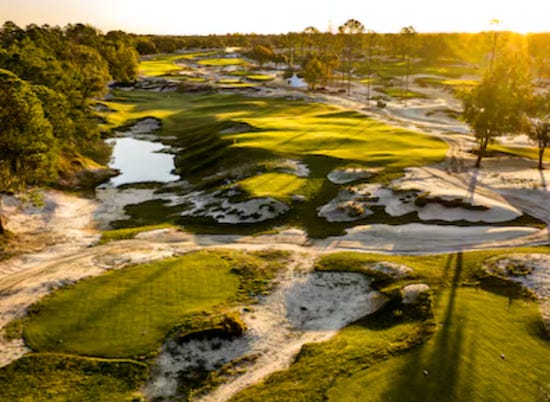
Candyroot’s first course, designed by Mike Koprowski, is due to open for preview play in November, ahead of a full public opening in spring 2027, when it will be added to NGF’s Facility Database, which marks its 90th anniversary in 2026. A second 18-hole course and a short course are already in active planning, with two more 18-hole layouts to follow. The owners have acquired more than 1,200 acres about an hour from both Charlotte, North Carolina, and Columbia, South Carolina, for what they describe as a multicourse resort retreat that will include publicly accessible golf, a lighted par-3 course for night play, lodging, and wellness amenities.
“The Sandhills offer some of the most compelling natural golf terrain in the country, and we recognized a clear opportunity to create a publicly accessible destination inspired by the land,” said Candyroot proprietor Aaron Oberman. South Carolina had just over 350 courses at the start of 2026, ranking 17th nationally, according to NGF data, with about two-thirds of those courses public, below the national average of 72%. The project is also targeting a market that appears underserved for public golf: NGF’s GolfMAP platform estimates Charlotte and Columbia have about 300,000 golfers between them, plus another 185,000 non-golfers who say they are very interested in playing, yet nearly half the golf holes in Columbia and almost 40% in Charlotte are private, both above the national average of about 28%.
LONG-TERM CAPITAL PLANNING ‘ESSENTIAL’ TO GOLF CLUB STABILITY
Long-term capital planning should sit at the center of every well-run golf club if facilities are to remain financially stable, maintain infrastructure, and avoid more costly problems later, according to experienced golf club chief executive David Shepherd, who argues that annual budgeting alone is not enough.
Shepherd said too many clubs still rely on short-term thinking, particularly when trading conditions are strong, and warned that without a clear picture of likely spending requirements over the next 10 to 20 years, decisions on subscriptions and capital approvals amount to little more than guesswork. “The only way that you can inform your board how much money they need to spend each year is by understanding yourself how much money will need to be spent on your property over the next 15 years or more,” he said. Shepherd said clubs should identify every major asset across the property — including irrigation systems, drainage, machinery fleets, clubhouse infrastructure, and maintenance facilities — assign realistic life spans and replacement costs, and build those figures into a rolling multi-year plan that is reviewed regularly.
“That number divided by the number of years, that is the amount of money that you need to put back into your club each year just to stay where you are,” he said, adding that once directors understand that figure, “luxury or vanity projects are reconsidered.” He warned that without consistent reinvestment, standards deteriorate as machinery is kept beyond its ideal life cycle, temporary fixes replace proper upgrades, and essential projects are delayed because they appear discretionary. “Without investing in your club, or without putting enough money back into your club for capital investment, it’s basically like having a luxury car and not servicing it and expecting it to run like new after five years,” he said.
Shepherd also said the strong post-Covid golf market has created a false sense of security, with full tee sheets and waiting lists making it easier for boards to delay harder decisions, when in fact, strong conditions are the right time to act. “Post-Covid golf is in a really good place, but it would be really easy to just go back to making quite short term decisions in golf clubs – not charging members what they need to pay and not making the right decisions for the long term, basically to protect the short term,” he said. “But when is the best time to make a difficult decision? When things are good.” He added that governance can worsen the problem when directors focus on their own terms rather than long-term stewardship, and said it is the responsibility of club executives to present the data needed to show the consequences of deferring investment. “Our job at our clubs is not just to keep the lights on – it’s to ensure they are stronger when we leave,” he said.
IFIT AND ARCIS GOLF EXPAND PARTNERSHIP ACROSS EQUIPMENT AND CONTENT
iFIT and Arcis Golf have expanded the partnership they began in 2025 through a dual agreement that makes Arcis an exclusive equipment partner across its portfolio of 88 private, resort, and public golf courses in the United States.
The continued arrangement gives iFIT exclusive rights to produce new golf-performance and golf-fitness content at Arcis properties. Under the agreement, Arcis will equip its clubs exclusively with iFIT brands, including Freemotion, iFIT-connected equipment, and the new NordicTrack Ultra 1 commercial treadmill, while iFIT will film new programming at Arcis destinations nationwide, positioning Arcis as the home of iFIT’s official golf-fitness content. The expanded partnership is already in place at The Club at Ruby Hill in Pleasanton, California, where Freemotion commercial strength equipment has been installed in the fitness center and is being used as the base for a new golf-focused strength training series on the iFIT platform designed to improve rotational power, stability, and control.
“This deepening partnership reflects our shared vision for the future of golf and fitness,” said Blake Walker, founder, chairman, and chief executive of Arcis Golf. “Our members will benefit from world-class fitness experiences on and off the course, while iFIT’s global audience will discover Arcis Golf through exclusive, beautifully produced training content.” Mark Watterson, chief executive of iFIT Commercial, said the two companies were “redefining how golfers train” by combining technology, coaching, and golf environments to help players improve performance and fitness.
INDOOR GOLF ALLIANCE LAUNCHES REDDIT COMMUNITY FOR GROWING SIMULATOR SECTOR
The Indoor Golf Alliance has launched the IGA Community on Reddit as a new online forum intended to connect the fast-growing indoor golf industry and bring greater structure to discussions already taking place across the platform.
The alliance said Reddit has become an increasingly important channel for golfers, simulator owners, instructors, facility operators, and entrepreneurs to exchange ideas, ask questions, and track developments in indoor golf, with thousands of users already active in conversations around golf simulators, launch monitor technology, indoor facility design, training methods, and home simulator setups. According to the IGA, those discussions offer real-time insight into products, customer experience, and emerging market trends, while the new community is intended to create a more centralized place for learning, collaboration, and industry growth.
The group added that the Reddit hub will also give companies and operators a space to introduce technologies, showcase venues, share instructional content, and promote leagues, tournaments, and events, with the broader aim of supporting innovation, education, and collaboration across the global indoor golf ecosystem.
PXG INTRODUCES STICK’EM FORGED WEDGES
PXG has introduced its new Stick’em Forged Wedges, a fully forged wedge line designed to deliver improved feel and control from a range of lies.
The new range combines a clean tour-inspired profile with modern performance features such as high-toe weighting, progressive center-of-gravity placement, and optimized groove spacing to promote consistent launch, stability, and spin throughout the set.

Available now in Chrome for $199 and Xtreme Dark for $219, the wedges are made from three-times forged 8620 soft carbon steel, a process PXG said tightens the grain structure to produce a softer yet more solid feel at impact, a crisp sound, greater strength, and tighter manufacturing tolerances. The company said high-toe weighting increases moment of inertia and aligns the center of gravity more effectively for open-face shots, while wider grooves and tighter groove spacing are intended to improve friction, channel away moisture and debris, and deliver more reliable spin and trajectory control.
“The short game is where players either gain confidence or lose it,” said Mike Nicolette, PXG senior director of engineering. “With Stick’em Forged Wedges, the goal was to give golfers a wedge that performs predictably shot after shot.” The wedges are offered in BP-Grind with 13 degrees of bounce, designed with a wider sole for steeper attack angles and softer turf or sand conditions, and S-Grind with 10 degrees of bounce, featuring heel and toe relief for greater versatility.
The line is available in 50, 52, 54, 56, 58, and 60 degrees of loft, with multiple shaft and flex options, while the 54-60 degree models feature full-face grooves for open-face shots, and the 50 and 52 degree versions use traditional grooves for full-swing control.
DOES THE PLAYERS STACK UP ECONOMICALLY WITH GOLF’S MAJORS?
Is The Players Championship the “fifth major”?
It’s a debate that has raged for some time now, but extra emphasis was placed on the inclusion of The Players as a major by the PGA Tour’s own “March is going to be major” messaging and by outside commentary, most noticeably by Brandel Chamblee’s claim that The Players is “the best major.”
The Tiger Woods-led Future Competitions Committee is not only looking at ways to alter the playing structure going forward, but also to elevate The Players further with proposals for a shorter PGA Tour season or promotion and relegation systems, which potentially make reaching the field for The Players even more of an achievement than qualifying for some of the major championships.
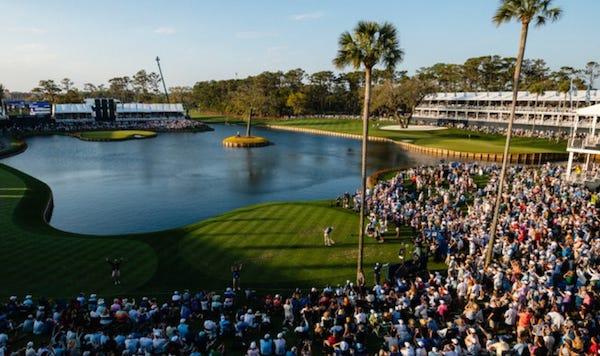
In his press conference on Wednesday, PGA Tour CEO Brian Rolapp chose to focus more on the PGA Tour’s future structure through the Tiger Woods-led Future Competitions Committee than on confirming the Tour’s desire to see The Players officially recognised as a major. Even Chamblee has backtracked from his earlier assertion that The Players is the best major.
From the GBR perspective, the more useful question is economic: does The Players generate the kind of force that places it in the same commercial conversation as golf’s established majors?
