


Hello GBR,
Just before the weekend gets underway, it’s time to have a look around to capture the leading golf stories.
Our focus before we get into today’s paid story looks at initiatives designed to develop golf and bring more people into the sport. Two stories standout.
Australian Golf has announced a new five year plan build around three pillars, which are not only promotes golf but helps protect existing facilities and enhancing them to support projected growth.
In the UK, the PGA of GB&I, reports on its PGA Play initiative, which helps beginners reach golf professionals for tuition through the PGA Play online portal. What’s impressive is the conversion rate of players who have one lesson following up and booking further lessons signposting their intent to play more golf and improve.
Our paid story today takes a look under the hood of Acushnet’s Q1 figures and compares them against the same period for last year.
Steady progress is being made, and the big question will be whether or not Acushnet can post strong H1 figures boosted by the impending launch of the GTS Series.
Enjoy, today’s GBR, and have a great weekend.
AUSTRALIAN GOLF SETS OUT FIVE-YEAR PLAN TO MODERNISE THE GAME
Australian golf has launched BIG SWINGS 2026–2030: The Next Evolution of Golf in Australia, a five-year national strategy designed to grow participation, strengthen facilities and make the game more accessible to a wider audience.
Launched at Golf Park Adelaide, the plan brings together Golf Australia, the PGA of Australia, the WPGA Tour of Australasia, clubs, PGA Professionals, venue operators and industry leaders behind a shared agenda. More than four million Australians now participate in golf across courses, driving ranges, simulator venues and social entertainment formats, with off-course venues doubling since the industry’s first strategy was launched. Golf Australia CEO James Sutherland said: “What started as a belief that all golf is golf is now how Australians actually play.”
The strategy is built around three pillars: EVOLVE, supporting more than 1,800 golf courses and facilities to adapt to modern customer expectations; BELONG, aiming for everyone in the golf community to feel welcome, with a focus on women, families and under-represented groups; and CONNECT, linking one million more golfers to the sport over the next five years. Sutherland said the aim was “more Australians experiencing the benefits of golf more often,” while PGA of Australia CEO Gavin Kirkman called it “a strategy for the whole of golf.”
WPGA Tour of Australasia CEO Karen Lunn said rising engagement from women, families and diverse communities made inclusion central to the plan. The strategy was shaped by more than 12,000 public survey responses and nationwide industry consultation, with implementation now focused on practical changes across clubs, facilities and participation programmes.
GOLF TRAVEL BECOMES A LARGER FORCE IN THE U.S. GOLF ECONOMY
The latest study from the National Golf Foundation highlights that golf travel is becoming one of the strongest growth areas in the U.S. golf economy, with more than 12 million Americans taking golf-related trips each year from 2022 to 2025.
That is 49% above recent pre-COVID levels and about 10% higher than the comparable period in the mid-2000s before the Great Recession. Golf travel is now the second-largest segment of the U.S. golf economy behind facility operations, generating more than $30bn annually in off-course tourism spending on travel, lodging, meals and incidentals, with a further $10bn linked to green fees, merchandise and food-and-beverage spending by travelling golfers.
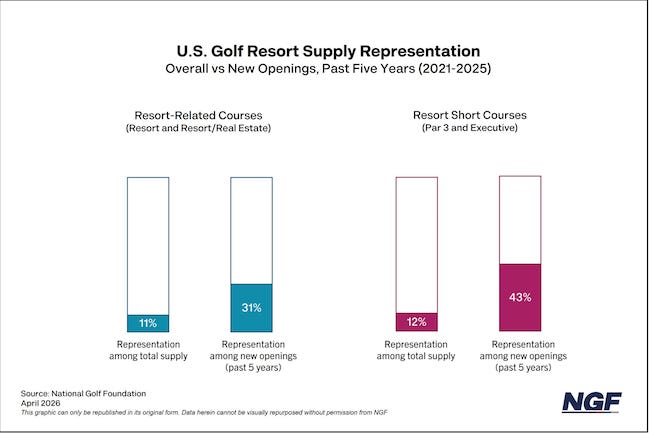
The rise in demand is also influencing golf course development. Over the past five years, almost one-third of new U.S. course openings have had a resort connection, compared with just over 10% of the country’s roughly 16,000 existing courses being tied to a resort or resort-real-estate property. Recent examples include new resort courses at Arcadia Bluffs, Big Cedar, Gamble Sands and McLemore, while Rodeo Dunes, Sand Valley and Wild Spring Dunes have held soft openings before official debuts this year. Private destination clubs such as Broomsedge, Old Barnwell and The Tree Farm are also drawing travelling golfers. Nearly half of golfers, 47%, say they expect to play while travelling in the coming year, underlining how golf trips are becoming a more social, experience-led part of the game rather than a niche travel category.
UNEEKOR LAUNCHES AI STUDIO TRAINING PACKAGE WITH REAL-TIME SWING ANALYSIS
Uneekor has launched AI Studio, its most complete training package to date, built around AI Trainer, an intelligent coaching engine that analyses more than 60 swing checkpoints in real time and gives golfers an instant personalised swing score after every shot. The system uses machine learning to capture each swing, identify what is happening at impact and turn the data into clear recommendations for players and coaches. Paired with two high-speed global-shutter Swing Optix cameras, the package combines slow-motion video with club-path, hand-path and setup-line analysis, helping golfers compare what they feel in the swing with what the data shows.
AI Trainer is available within the Uneekor AI Studio bundle across the company’s overhead launch monitor range, including EYE XR, EYE XO and EYE XO2. Each AI Studio package includes a Uneekor overhead launch monitor, Swing Optix cameras and tripods, a full year of AI Trainer software, and a three-month trial of the Ultimate Package, which unlocks GAME DAY, Uneekor’s 4K golf simulation software. Uneekor said the system is already being used by coaches and facilities to create baseline assessments, track movement improvements and measure progress over time. “Golfers can have every metric in front of them and still not know what to work on,” said Tarick Walton, Uneekor’s Head of Product Management. “AI Trainer takes what the system sees at impact and turns it into something they can actually act on.”
PGA PLAY TURNS ONLINE LESSON SEARCHES INTO NEW GOLF PARTICIPATION
PGA Play, the PGA of Great Britain and Ireland’s consumer-facing coaching platform, is now in its fourth year and hosts more than 1,800 PGA Member profiles, giving professionals a free online presence while connecting beginners directly with qualified coaches. The platform is responding to clear search demand, with more than 1.5 million annual UK searches for terms such as “golf lessons near me” and “golf coach”. Over the past 12 months, PGA Play has generated 11,000 lesson enquiries, engaged 192,000 users, recorded 263,000 profile views and driven 36,000 clicks to PGA Member booking platforms and websites. “It’s just showing what’s available to the consumer,” said Scott Garrett, Head Professional at Gailes Golf & Leisure in Scotland. “It’s easy even for a non-golfer to go on there and understand it pretty quickly.”
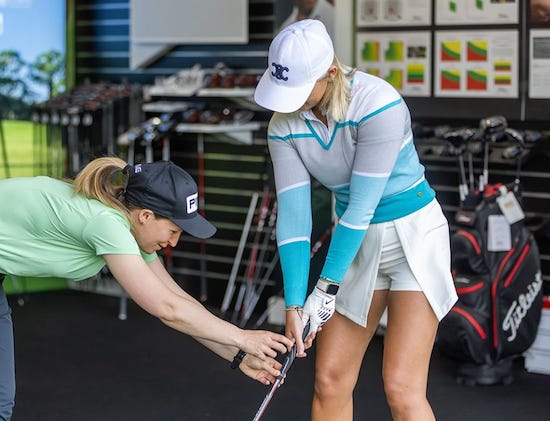
The PGA’s survey data suggests the platform is converting interest into action, with 74% of respondents booking a golf lesson after using PGA Play, 73% identified as beginners, and 70% booking a one-to-one lesson, while 25% booked a series of one-to-one sessions. A follow-up survey three months later found 72% had taken coaching, 78% rated the impact as excellent or good, and 66% were highly likely to continue coaching and recommend lessons. PGA Play is also reaching strategically important audiences: more than 40% of users are under 35, more than a quarter are women, and 72% of non-club golfers using the platform said they were considering joining a club. The platform also supports beginners through website, social media and newsletter content, positioning it as a pathway from initial search to lesson booking, ongoing play and potential club membership.
PGA TOUR TO EXPAND PLAYER SOCIAL MEDIA RIGHTS AS YOUTUBE GOLF GROWS
The PGA Tour is preparing to introduce an updated player social media policy that will expand what players can film and publish from tournament sites, as content creation becomes a more prominent part of the professional game.
The revised rules, presented to the Player Advisory Council fans subcommittee at the Truist Championship and expected to be rolled out later this month, are designed to align on-site content permissions with existing off-site guidelines that already allow players to share non-live, post-produced material.
The move comes as players such as Bryson DeChambeau continue to build large digital audiences, with DeChambeau stating this week that prioritising YouTube content alongside major championships in 2027 was “an incredibly viable option,” while also noting that previous Tour rules restricted filming during event weeks.
Revised PGA Tour social media rules:
Players can post three minutes of on-site content during competition days, up from two minutes
There is no limit on player-created content from non-competition days, including practice rounds and pro-ams
After TV coverage ends, players can post broadcast footage of up to six shots per round, capped at one minute, up from one shot previously
Archive footage use after an event ends rises to eight minutes per video, up from five
Players can now use up to 120 minutes of archive footage in total on a YouTube channel, up from 60
Players can earn Google AdSense revenue from practice and pro-am content filmed on-site
The PGA Tour will claim revenue through YouTube Content ID for videos containing competition-round footage
Players no longer need to transfer ownership of their YouTube channel to the Tour to use archive footage
The policy update reflects a broader shift within the PGA Tour as it responds to growing demand for player-led content, with several members already building audiences online, including Jason Day and Tommy Fleetwood.

Players involved in the PAC fans subcommittee include Rickie Fowler, Justin Thomas and Max Homa, as the Tour looks to balance media rights with the commercial and engagement opportunities created by social and digital platforms. David Rumsey’s full article in Front Office Sports can be read here.
ACUSHNET DELIVERS Q1 GROWTH, NEXT PHASE HINGES ON NEW EQUIPMENT CYCLE
Acushnet’s first-quarter 2026 figures offer a useful reading of where the premium golf equipment market stands at the start of the year. The company is growing, its core Titleist equipment business remains strong, and demand appears broadly healthy across most major regions. But the results also show how much Acushnet’s performance continues to depend on product timing, regional execution and the resilience of its most established categories.
For the three months to March 31, Acushnet reported net sales of $753.0 million, up 7.1% on the same period last year, or 4.8% on a constant currency basis. That compares with Q1 2025, when net sales were $703.4 million and effectively flat year-on-year, down 0.6% as reported but up 1.2% in constant currency.
The comparison matters because Q1 2026 looks less like a rebound from weakness and more like a return to steadier expansion. Acushnet’s results were not driven by one isolated product line. Growth came through golf balls, golf clubs and golf gear, while regional performance improved in the United States, EMEA, Japan and Rest of World. Korea was the notable exception.
