Modern F&B at the Course: How Clubhaus Is Redesigning the On-Course Hospitality Experience
A frictionless ordering platform that helps clubs increase revenue, shorten turn times, and give golfers the premium experience they now expect.

ORLANDO. Food & beverage is one of the most essential — and most underestimated — components of a golf facility’s business model. Despite rising expectations around hospitality, speed and convenience, operators still rely on legacy workflows: beverage carts that may or may not appear when needed, turn-house lines that clog pace of play, and radio-based ordering systems that strain staff bandwidth. While golfers have changed, and their expectations have changed, course F&B operations have remained largely the same.
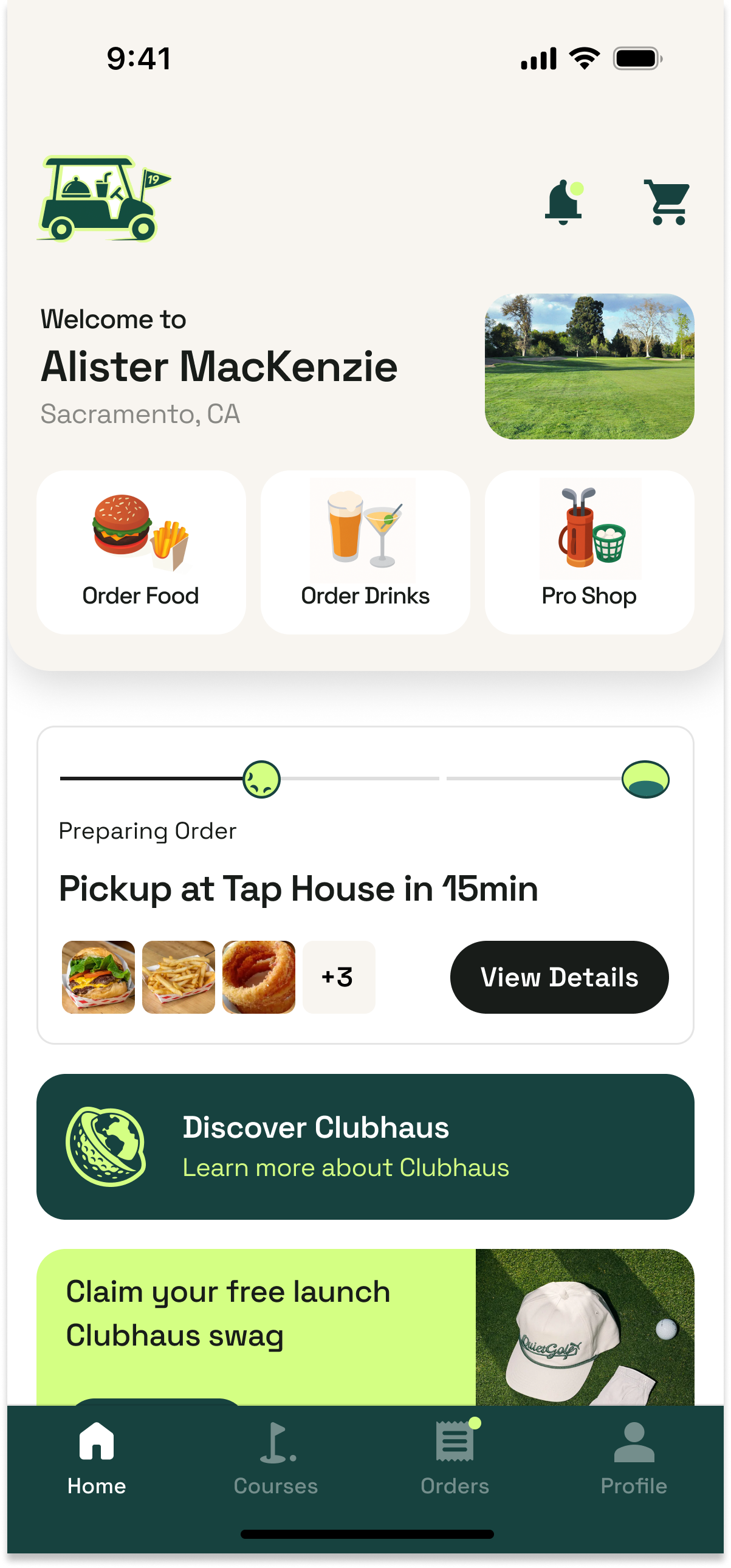
This is the landscape into which Clubhaus steps — not with another heavy POS system, nor with a labor-intensive solution, but with a clean, mobile-first ordering experience that lets golfers place F&B orders from anywhere on the property — including the driving range, where operators are seeing some of the strongest demand and revenue upside heading into 2026. Orders are sent directly to a simple iPad interface for staff, and fulfillment meets golfers at the next hole or at the turn. No POS integration. No contracts. No additional staffing.
The simplicity of the model masks the scale of the operational friction it removes.
The F&B bottleneck every operator recognizes
Ask any GM, F&B director or head professional, and the pattern is the same:
– Golfers want to order more than the club can practically fulfill
– Staff can’t physically cover the course efficiently
– Turn-house congestion disrupts pace of play
– Missed orders translate directly into lost revenue
– Existing POS systems were built for restaurants, not fairways
The fundamental issue is one of timing. Golfers only buy when the opportunity is physically in front of them. Clubhaus changes the equation entirely by turning that opportunity digital and continuous.
How Clubhaus works
What makes Clubhaus immediately attractive to operators is that it requires virtually no lift.
The system works as follows:
– Golfers scan a QR code at any point on the course
– They browse the menu and order within seconds
– Staff receive the order via a clean, dedicated iPad app
– The club fulfills the order either at the next hole, the turn or a designated pickup point
– No POS integration is required, meaning no IT overhead and no vendor lock-in
This removes the single biggest adoption barrier for operators: integration complexity.
Experienced restaurant staff will already be familiar with similar workflows from platforms like UberEats and DoorDash. This ease of adoption keeps staff off the phone and focused on what matters most — serving guests directly in front of them.
What operators gain immediately
The impact of Clubhaus becomes visible fast:
1. Increased F&B revenue
Demand that previously went unrealized — because golfers couldn’t find the cart, or because lines were too long — begins to convert. Courses typically see a 10–20% increase in average daily order volume.
2. Improved pace of play
Golfers aren’t forced to cluster around a turn-house window during peak times. Early testing indicates that total round times decrease by 10–15 minutes because golfers no longer need to queue at the turn.
3. Better member and guest experience
The experience feels modern, convenient and aligned with today’s hospitality expectations.
4. Zero additional staffing pressure
Orders flow to staff without adding operational complexity.
For public courses, this can mean steadier revenue across busy weekends. For private clubs, it becomes a member-experience differentiator that requires minimal operational change.
Why this matters heading into Orlando
The modernization of golf operations has accelerated rapidly — launch monitors, digital check-ins, app-driven tee sheets, dynamic pricing models, and more. Yet F&B remains one of the last unmodernized pillars, creating an experience gap between what golfers expect and what most facilities can deliver.
In 2026, operators are confronting:
– tighter labor markets
– rising guest expectations
– margin pressure on F&B
– the need to boost per-round revenue without disrupting play
– a growing emphasis on hospitality consistency
Clubhaus sits directly at this intersection: a way to upgrade the guest experience, increase revenue and reduce friction — all at once, with minimal operational disruption.
Built for golf by someone who knows hospitality technology
Clubhaus reflects the background of its co-founder, Michael Addison, whose career spans leadership and enterprise sales roles at Toast, OpenTable, GolfNow, and high-growth SaaS platforms.
His experience building systems for multi-location, high-volume hospitality operators directly informs the design philosophy behind Clubhaus: simple deployment, low friction, high ROI and a focus on immediate operator value.
Where the platform goes next
The long-term roadmap opens several natural expansion paths:
– deeper loyalty and rewards integration
– branded merch rewards and partner drops
– expanded features for private clubs
– enhanced operational automation for staff
– more granular reporting for operators
But even without future expansion, Clubhaus already solves a problem every operator can describe — and few can fix — in under 10 seconds.
The value proposition at the PGA Show will be instantly clear:
Show a golfer a QR code. Let them order. Deliver it.
The simplicity will do the work.
Clubhaus will increase F&B orders by up to 20%, reduce round times by up to 15 minutes, and reduce calls to both the clubhouse and restaurant.
👉 More information available at JoinClubhaus.com
📍 ORLANDO · PGA SHOW 2026 — Visit the Clubhaus team at Booth 2484